
The CGI portal is the online U.S. visa appointment system that CGI Federal runs for the U.S. Department of State, where applicants create an account, pay the visa application fee, and schedule a consular interview. Most people reach it through ustraveldocs.com or usvisascheduling.com, depending on the country. A student in Mumbai, an H-1B worker flying home for a visa stamp, and a Texas family sponsoring a parent’s visit all use the same system. Each of them runs into the same fee rules, the same appointment limits, and the same login errors.
This guide covers each step in order: account setup, fees, booking, error fixes, and the 2025–2026 policy changes that affect every applicant.
What Is the CGI Portal?
The CGI portal is the applicant-facing website of the visa support contract that CGI Federal holds with the State Department’s Bureau of Consular Affairs. You’ll use it for three jobs: paying the Machine Readable Visa (MRV) fee, booking an interview or biometrics slot, and managing your applicant profile. The visa application itself doesn’t happen here. You file the Online Nonimmigrant Visa Application (DS-160) on the Consular Electronic Application Center (CEAC) website first, then bring its confirmation number to the portal.
Who Runs the CGI Portal?
CGI Federal, the U.S. government arm of Canadian IT firm CGI Inc., runs the CGI portal under State Department contract. CGI says it serves roughly 5 million U.S. visa applicants a year across 72 countries in 39 languages. Its contracted services include call center support, fee collection, appointment services, and offsite collection of applicant biometrics. Internally, CGI calls this system CGI Atlas360, built on its CGI CustomerAdvance customer-relationship platform.
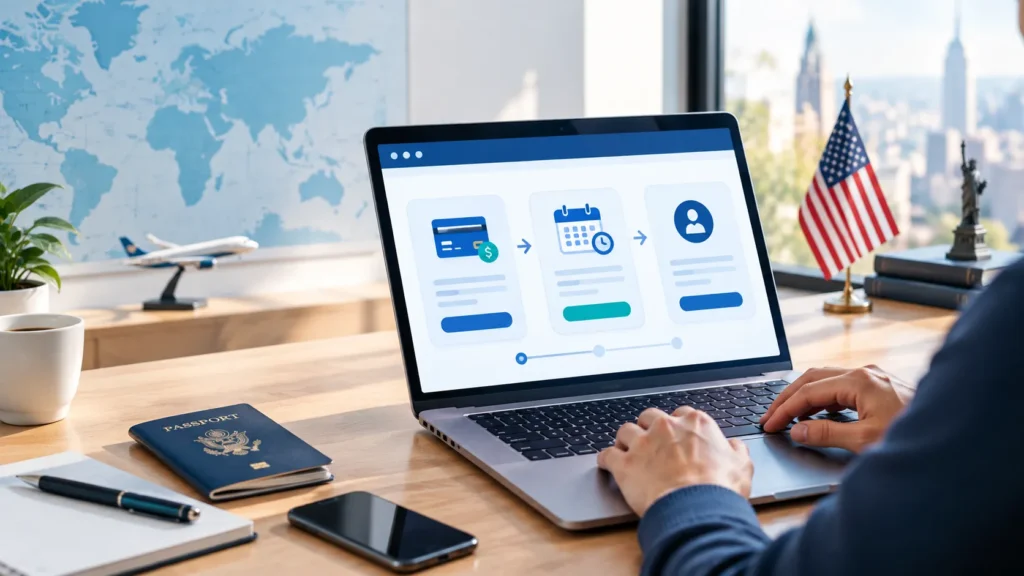
The contractor handles the logistics. The decision on your visa belongs to a consular officer at the embassy, and CGI staff can’t influence it.
Which Visa Appointment Portal Does Your Country Use?
Your country’s U.S. embassy website names the one scheduling portal you must use, and no other portal will accept your application for that post. The State Department doesn’t use a single worldwide site. Booking redirects to country-specific platforms such as USVisaScheduling.com, AIS US Visa, the CGI Federal website, or USVisaAppt.com.
| Portal | Status | Example |
| ustraveldocs.com | Legacy CGI system, still active at some posts | India’s embassy still routes emergency appointment requests through UStraveldocs |
| usvisascheduling.com | Newer CGI system | Applicants in India, including those with old-system accounts, now book through usvisascheduling.com |
| ais.usvisa-info.com (AIS) | Separate platform used by other posts | Canada’s fee page sits on this domain |
| usvisaappt.com (AVITS) | Separate platform used by other posts | Lets applicants in covered countries create an account, pay fees, and schedule appointments |
Provider changes happen without much warning. In August 2024, the U.S. Embassy in Monrovia paused all visa scheduling while it moved to a new services provider, and ustraveldocs.com stopped working for Liberia. Check the embassy’s visa page before you pay anything, because fees don’t move between platforms.
What Do You Need Before You Log In?
You need a valid passport, a submitted DS-160 confirmation number, a working email address, and a payment method your country’s portal accepts. Gather these five items before you start:
- Passport: The portal builds your profile around your passport number, so use the passport you’ll travel with.
- DS-160 confirmation number: A 10-character code that starts with “AA,” printed on your CEAC confirmation page.
- Email address: Pick one you’ll keep for at least 12 months, since receipts and appointment letters go there.
- Payment method: Options include bank transfer, cash deposit, and card, depending on the country.
- Petition or program documents: Examples include a Form I-797 approval notice for H-1B workers and a Form I-20 for F-1 students.
How Do You Create a CGI Portal Account?
You create an account by registering your email, setting security questions, and linking your passport and DS-160 details to a new applicant profile. The steps below follow the usvisascheduling.com flow. Older ustraveldocs pages use different button labels but the same order.
- Register your email. Open your country’s portal from the embassy website, choose “New User,” and enter the verification code sent to your inbox.
- Set security questions. The system asks you to pick answers from three separate dropdown menus, then sign in with your username, password, and a CAPTCHA code.
- Accept the privacy terms. A screen shows CGI Federal’s privacy policy and unauthorized-access rules, and you tick a checkbox to continue.
- Complete your profile. Enter your contact email, country, and preferred language.
- Add applicants. Enter each traveler’s passport details, including children who need their own visas.
- Link your DS-160. Type the “AA” confirmation number exactly as CEAC shows it.
Create one profile per passport. The ustraveldocs site tells applicants not to open a new profile if one already exists and to log in and edit the existing one instead.
Which CGI Websites Are Not the Visa Portal?
Three CGI login pages have no connection to visa appointments: My Health Portal, CGI Insurance Information Services (RapidWeb), and a corporate sign-in gateway at authmobile.ent.cgi.com. Search results for “cgi portal” often show these pages first because they sit on CGI’s own domain. My Health Portal is a contact form for a healthcare product, and the RapidWeb page is a login for CGI Insurance Information Services.
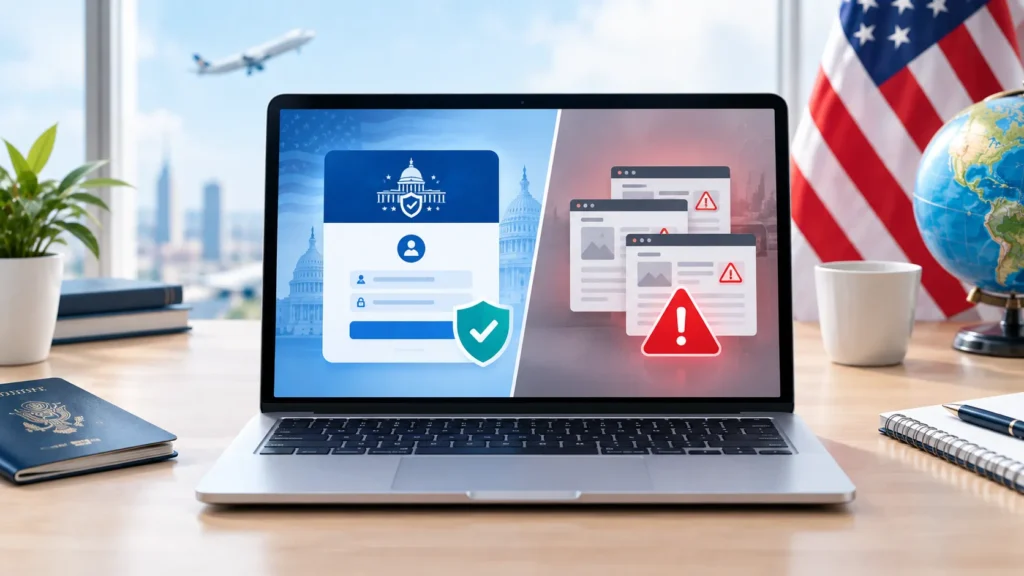
Entering your visa credentials on any of these pages won’t work. It also exposes your password to a system that was never meant to receive it.
How Do You Book, Reschedule, or Cancel an Appointment?
You book, reschedule, or cancel from the portal dashboard once your fee shows as paid and your DS-160 number is linked. Pick the consulate, then the earliest date that fits your travel plans. Save the appointment confirmation letter as a PDF right away. Security staff at many embassies ask for a printed copy at the gate.
Changes are allowed but limited. Canada’s portal lets applicants cancel or reschedule within the same country at no added cost, although the system caps how often you can move a date. A warning that you’ve reached the rescheduling limit means a missed or failed booking will require a new MRV payment.
How Do You Request an Emergency Appointment?
You request an emergency appointment by booking the earliest regular slot first, then submitting an expedite request through the portal with proof of urgent travel. Qualifying reasons include a family member’s serious illness, a funeral, and urgent medical treatment. Consular managers at every post can still grant free expedited interviews for humanitarian reasons or urgent travel that serves U.S. interests.
How Does the $750 Paid Expedite Option Work?
The Paid Expedite pilot lets B-1/B-2 applicants pay $750 for an interview within 10 business days at participating embassies. The program runs from July 1, 2026, through December 31, 2026. Here’s the order:
- Book a regular appointment. You pay the $185 MRV fee and schedule a standard interview first.
- Request the upgrade. Sign in, click “Continue,” choose “Request Expedite,” and select “Paid Expedite.” The option appears only when your country takes part, slots are open, and you meet the eligibility rules.
- Pay within 10 minutes. The $750 payment has to go through within 10 minutes or the slot is released.
The trade-offs are strict. An expedited date can’t be changed once booked, and a missed appointment forfeits the fee. Paying doesn’t speed up administrative processing either. The State Department projects capacity for 25,000 expedited requests during the pilot.
Can You Still Get an Interview Waiver?
Yes, but only a few applicant groups qualify for an interview waiver after the October 1, 2025, policy change. Most nonimmigrant applicants, including children under 14 and adults over 79, now need an in-person interview. The main exceptions are B-1/B-2 or Border Crossing Card renewals and H-2A renewals within 12 months of the prior visa’s expiration, where the earlier visa was issued at full validity and the applicant was at least 18.
Three more conditions apply. You must apply in your country of nationality or usual residence, have no uncured prior visa refusal, and show no apparent ineligibility. Officers can still call anyone in for an interview. Choose “interview waiver” in the portal only if you meet every one of these conditions, because a wrong selection costs you weeks.
How Do You Pay the Visa Application Fee?
You pay the MRV fee inside the portal after your profile is complete, using the methods your country’s embassy approves. Timing depends on the method. Canada’s portal, for example, says a cash payment takes up to 2 business days to register, and a cash payment slip covers only one transaction. You can’t book an interview until the portal shows the fee as paid. U.S. Department of State
How Much Is the MRV Fee?
The MRV fee is $185 for most visitor and student visas and $205 to $315 for petition-based and treaty visas.
| Visa category | Examples | MRV fee (USD) |
| Non-petition-based | B-1/B-2, F-1, J-1, M-1 | $185 |
| Petition-based | H-1B, L-1, O-1, R-1 | $205 |
| Treaty trader/investor | E-1, E-2 | $315 |
| Fiancé(e) | K-1 | $265 |
Your total bill can run higher. Applicants from some countries owe a reciprocity-based issuance fee after approval. Students add a SEVIS fee of $350 for F and M visas, and most J-1 exchange visitors pay $220.
How Long Is the Fee Receipt Valid?
An MRV fee receipt stays valid for 365 days (12 months) from the payment date. The receipt only works in the country where you paid it, so money paid for an appointment in one country won’t book a slot in another. Timing matters for anyone who reschedules often. If you cancel an appointment after the 365-day window closes, you’ll pay the fee again before you can book a new date.
Is the MRV Fee Refundable?
No, the MRV fee is not refundable, even if the consular officer refuses your visa. The State Department describes it as a processing fee that most applicants owe whether the application ends in approval or refusal. A second, separate application needs a second fee.
Does the $250 Visa Integrity Fee Apply Yet?
No, the $250 Visa Integrity Fee is not being collected yet. Congress created the fee in 2025, but as of July 28, 2026, the State Department’s fee schedule listed no amount, payment portal, or collection procedure for it. Treat any third-party calculator that adds $250 to your total as ahead of official policy.
What Should U.S.-Based Applicants and Sponsors Do Differently?
U.S.-based visa holders need to book in their home country, and U.S. sponsors should help applicants book only through the official embassy-linked portal. Since September 6, 2025, the State Department has told nonimmigrant applicants to schedule interviews in their country of nationality or residence. Applying elsewhere is still allowed, but it makes qualifying harder.
For H-1B workers in Seattle or Austin, that ends the old habit of booking a quick visa stamp in Canada or Mexico. Plan a trip home and book early, because interview waivers rarely apply now.
Parents sponsoring a visiting relative face a different problem: they don’t control the account. Sit with your relative on a video call while they register, so the profile uses their own email address and passport. Don’t create the account in your name. The profile belongs to the traveler, and support staff speak only with the account holder.
Employers who pay the MRV fee for staff get no extra flexibility. Each receipt belongs to one applicant in one country.
How Do You Spot a Fake Visa Appointment Site?
You spot a fake site by checking that you reached the portal through a .gov embassy link and that the page calls itself the official State Department appointment service. Genuine portals label themselves plainly. The usvisascheduling.com page carries the heading “Official U.S. Department of State Visa Appointment Service.”
Doubts are common, even among experienced applicants. One H-1B worker posted on a tech forum asking whether usvisascheduling.com and ustraveldocs were legitimate, because the sites looked unfamiliar. Red flags include agent websites that charge “booking fees,” WhatsApp sellers offering guaranteed slots, and payment requests through personal bank accounts. The official portal never sells appointments for extra cash outside the $750 pilot.
How Do You Fix Common CGI Portal Errors?
Most CGI portal errors come from duplicate profiles, incomplete account migration, or expired fee receipts, and each one has a specific fix.
| Error message or problem | Cause | Fix |
| “Your personal details match the profile which already exists” | Your passport number matches an existing profile, since the system creates one profile per passport | Log in to the original account, or file a query through the portal’s feedback option |
| Paid fee or appointment missing after migration | Records didn’t carry over from U.S. Traveldocs to the new system | Email your consulate’s support address, such as support-india@usvisascheduling.com, and ask for the migration. Don’t pay again, because the second fee won’t be refunded. |
| “One or more receipts have expired” | The 365-day validity has passed | Keep your current appointment unless you’re ready to pay a new fee |
| Wrong country locked on profile | Profile was created for another country | Contact that country’s support email with your passport details and request a transfer |
| DS-160 number rejected | Typo, or you edited the DS-160 and got a new number | Enter the latest “AA” number from your CEAC confirmation page |

How Do You Contact CGI Portal Customer Support?
You contact support through your country’s dedicated email address, phone line, or the chat tool inside the portal. Each embassy publishes its own channels. India’s support team, for example, uses support-india@usvisascheduling.com, aims to reply within 3 working days, and runs a U.S.-based phone line at +1 332 220 1866.
Before emailing, gather your passport number, MRV receipt number, and a screenshot of the error. Support staff can fix account problems. They can’t approve a visa, promise an appointment, or change a consular decision.
FAQs
Is the CGI portal an official government website?
Yes. CGI Federal operates the site under contract, but every fee and appointment connects to the U.S. Department of State. Reach it through your embassy’s .gov page to avoid lookalike domains.
Can one MRV fee payment cover two applicants?
No. Each receipt is tied to a single passport holder and the country where it was paid. A family of four traveling together needs four separate payments.
What happens if I miss a paid expedited interview?
You lose the $750. Paid Expedite bookings can’t be moved after confirmation, and the State Department keeps the fee when an applicant doesn’t show up.
Do U.S. citizens need an account on the CGI portal?
No. Americans don’t apply for U.S. visas. A citizen might log in only to help a relative, while passport problems abroad go to the embassy’s American Citizen Services unit.
Can I book my visa interview in a third country?
Yes, but approval odds drop. State Department guidance since September 2025 directs applicants to their country of nationality or residence, and officers hold outside applicants to a stricter standard.
Conclusion
The CGI portal handles the logistics of your U.S. visa: account setup, the MRV fee, and your interview date. Your embassy’s website decides which version you use, whether that’s ustraveldocs.com, usvisascheduling.com, or a different platform. Pay only after confirming that link, since receipts stay locked to one country for 365 days. The $750 Paid Expedite option for B-1/B-2 applicants closes on December 31, 2026, unless the State Department extends the pilot.