
Japan welcomes 68 nationalities visa-free for 90 days, but everyone else needs to know exactly what documents, fees, and timelines apply to their situation. This guide answers the questions that delay your plans: Do you need a visa? Which type? How long does processing take, and what will it cost? We cover seven visa categories (tourist, work, student, family, working holiday, digital nomad, and emerging options), the precise documents each requires, realistic application timelines from start to embassy approval, common rejection reasons and how to avoid them, and the six-step process to secure your visa. Whether you’re taking a short vacation, moving for employment, or enrolling in language school, you’ll find your specific requirements, not a one-size-fits-all explanation.
Do You Need a Japan Visa? Quick Check by Nationality
Citizens of 68 countries can enter Japan visa-free for 15 to 90 days without applying in advance at an embassy or consulate, your nationality determines eligibility, not your place of residence. If you hold a passport from the United States, United Kingdom, Canada, Australia, Germany, France, South Korea, or most other EU nations, you can arrive at the port of entry and receive temporary visitor status automatically. The standard exemption period runs 90 consecutive days, though some countries receive shorter windows: nationals of Thailand and Brunei get 15 days, while certain Middle Eastern nations qualify for 30 days. Always confirm your country’s specific allocation with the Ministry of Foreign Affairs of Japan website before booking flights.
Who Must Apply for a Formal Visa
A Japan visa requirement applies only if your nationality isn’t on the exemption list or your planned stay exceeds the visa-free period. Countries requiring visas include China, Russia, Philippines, Vietnam, and several others across Africa and Central Asia; citizens of these nations must apply at a Japanese embassy or consulate in their home country 4 to 8 weeks before travel.
How Do Visas, Landing Permission, and Status of Residence Differ?
A visa is administrative approval from a Japanese diplomatic mission abroad allowing you to board a flight toward Japan’s border, but it doesn’t guarantee entry, an immigration officer at the port of entry decides whether to grant landing permission, the actual authority to step into Japan’s territory. Once cleared, you receive status of residence (shokugyo katudou joutai), the official document showing which activities you’re permitted to do in Japan: work, study, engage in business, visit family, or travel as a tourist. Many travelers conflate these three layers (visa, landing permission, status of residence), causing confusion, but understanding the distinction prevents costly application mistakes.
| Concept | Definition | Issued By | Timing | Purpose |
| Visa | Embassy approval to board a flight to Japan | Japanese Embassy/Consulate abroad | Before travel | Permission to enter Japan’s airspace |
| Landing Permission | Border officer’s approval to enter Japan | Immigration officer at port of entry | Upon arrival | Actual authorization to step into Japan |
| Status of Residence | Official document specifying permitted activities | Immigration Services Agency | After landing approval | Defines what you can do in Japan (work, study, tourism) |
Seven Visa Categories for Different Travel & Work Purposes
Japan’s visa structure divides into short-term stays (15 to 90 days) and long-term stays (91+ days). Temporary Visitor Status grants visa-exempt nationals (68 countries) automatic entry for 15 to 90 days upon arrival at immigration, no advance visa needed. Permitted activities include sightseeing, visiting family and friends, attending conferences, and business meetings, but earning payment from a Japanese employer isn’t allowed.
Tourist Visas: For Nationals Without Visa-Free Access
Tourist visas serve nationals ineligible for visa exemption, requiring a letter of invitation, 6-month bank statement showing average daily balance, and basic personal documents; processing takes 5 to 7 business days and allows stays up to 90 days on single-entry or double-entry visas valid 3 to 6 months.
Work Visas: Five Professional Categories Explained
Work visas divide into five categories: Engineer (university degree or 10+ years experience), Specialists in Humanities (English teachers, translators, researchers with comparable qualifications), Intra-Company Transferees (1+ year prior employment, same company), Skilled Labor (culinary specialists, architects, sports instructors; 3+ years required), and Business Managers (company startup or investment).
Student Visas: Institution-Sponsored Entry for Academic Programs
Student visas route through educational institutions, your school submits a Certificate of Eligibility to the Immigration Services Agency (4 to 12 weeks processing), then you apply at a Japanese embassy for 5 to 7-day approval, covering full-time university, language school, and exchange program participants.
Working Holiday Visas: One-Year Work & Travel for Ages 18–30
Working Holiday visas target ages 18 to 30 from 30+ countries (USA, UK, Canada, Australia included), requiring proof of funds (¥250,000–¥300,000 or $1,700–$2,000 USD), a return ticket, and no prior working holiday experience in Japan; processing takes 2 to 4 weeks.
Family Visas: Spouse and Child Sponsorship Visas
Family visas permit spouses and children of Japanese nationals or permanent residents indefinite stays with work permission, requiring marriage certification (apostille-certified if issued abroad), proof of stable income, birth certificates, and family registration (koseki touon) for Japanese parents.
Emerging Visa Categories: Digital Nomad, J-Skip, and J-Find (For High-Earners & Specialized Professionals)
Emerging visa categories reflect Japan’s labor shifts: J-Skip visas target highly skilled professionals earning ¥10 million+ annually or holding advanced degrees in specialized fields, offering faster permanent residence eligibility; J-Find visas support Future Creation Individuals working in emerging industries with ¥2 million+ annual income thresholds; Digital Nomad visas allow remote workers 1-year stays provided they earn ¥2 million+ annually from overseas sources and maintain health insurance.
Essential Documents: What You’ll Need to Submit
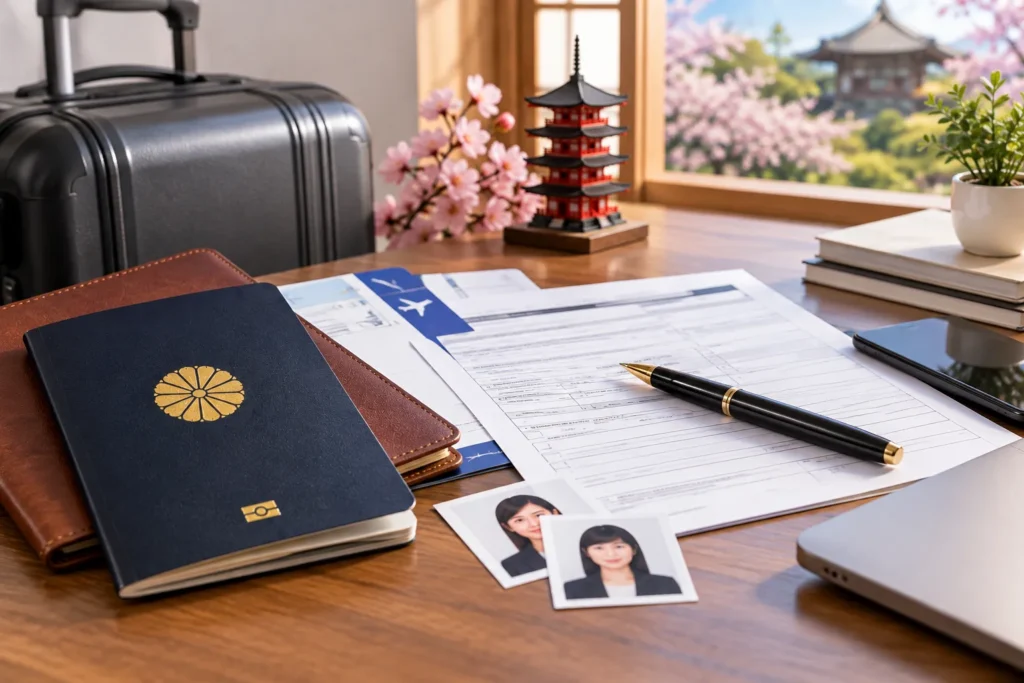
1. Tourist Visa Document Checklist
Tourist visas require a letter of invitation, accommodation confirmations, return flight itinerary, and bank statement (employer recommendation letters strengthen applications).
2. Work Visa Document Requirements
Work visas demand your employment contract, job description, company registration documents (kaisya touon), company tax statements (nozei shomei), resume, university diploma (if required), and bank statement,plus an official sponsorship letter from your employer explaining hiring rationale and confirming salary and duration.
3. Student Visa Document Requirements
Student visas require your Certificate of Eligibility (from your school), acceptance letter, proof of educational background, proof of funds covering tuition and living expenses, school guarantee letter, and sometimes English-language test scores (TOEFL or IELTS) if enrolling in English-taught programs.
4. Working Holiday Visa Document Requirements
Working holiday visas simply need proof of funds (¥250,000+ bank statement), return flight itinerary, understanding-of-conditions letter confirming you won’t exceed 40 hours weekly work during school terms, and basic personal documents,no sponsorship or employer verification required, unlike other visa types.
How Long Does Japan Visa Processing Take? Timeline & Fees by Visa Type
Standard processing takes 5 to 7 business days from the date of submission at a Japanese embassy or consulate, assuming all documents are complete and correct. Weekends and Japanese public holidays don’t count toward processing time. If the embassy deems your case complex or requires consultation with Tokyo headquarters, timeline extends to 2 to 3 weeks. Business visas and work visas sometimes take longer, up to 4 weeks, because sponsoring companies must submit additional verification.
Visa fees vary significantly by nationality and visa type. American visa applicants typically pay $140 USD for a single-entry tourist visa or work visa. Canadian citizens pay CAD $200. Australian and UK nationals pay AUD $240 and £104, respectively. These fees are non-refundable even if your application is rejected. Multiple-entry work visas cost roughly twice the single-entry fee. Express processing doesn’t exist at Japanese embassies; applications are processed in the order received, regardless of submission date. Some private visa agencies offer expedited document review (checking for errors before submission), but this doesn’t speed official processing.
Re-application fees apply if your visa is rejected. Pakistan and Philippines nationals, for example, cannot reapply for 6 months after a denial. When you resubmit, you’ll pay the full visa fee again,a costly mistake that makes complete preparation essential before your first attempt.
Six-Step Application Process: From Embassy Appointment to Visa Approval
Step 1: Identify Your Jurisdiction and Correct Embassy
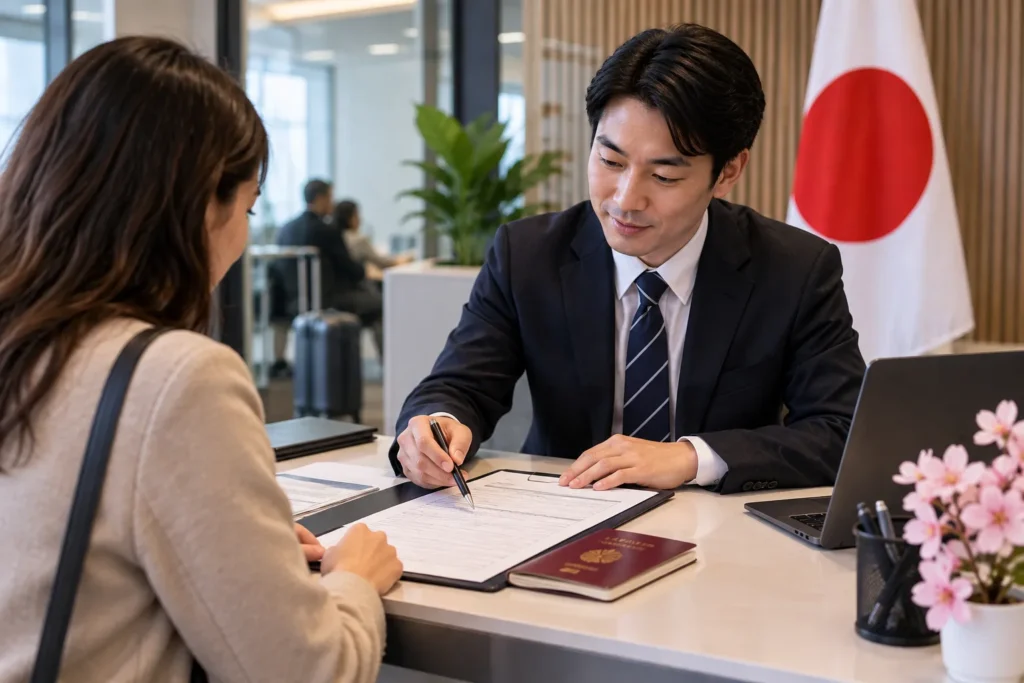
Your first step is identifying the correct embassy or consulate for your location. Japan maintains 185+ embassies and consulates worldwide. You must apply through the diplomatic mission that has jurisdiction over your place of residence, not your birthplace or passport-issuing country. Check mofa.go.jp for your nearest office and their specific requirements, slight variations exist by location.
Step 2: Gather All Required Documents
Gather all required documents before scheduling an appointment. Create a physical checklist and cross off each item as you collect it. Incomplete applications are rejected on the spot; you’ll need to reschedule weeks later after acquiring missing papers. Many embassies don’t review incomplete files or notify applicants in advance.
Step 3: Submit Your Application in Person
Submit your application in person at most embassies (though some now accept mail or use visa agencies). Arrive early with all originals and copies. The visa officer will briefly review your documents for obvious gaps. They won’t verify accuracy or authenticity at submission, that happens later, but they’ll reject incomplete packages immediately.
Step 4: Pay Your Visa Fee
Pay your visa fee in local currency at the time of submission. Some embassies require exact cash; others accept cards or bank transfers. Ask in advance to avoid delays. You’ll receive a receipt or reference number to track your application’s progress.
Step 5: Check Your Application Status
Wait for processing and check your application status. Don’t expect calls or emails, embassies generally contact you only if they need additional information. Most embassies allow phone calls or website inquiries to check status after 5 business days.
Step 6: Collect Your Approved Visa or Reapply If Denied
Return to the embassy on your assigned collection date to pick up your passport. Most embassies allow phone calls or website inquiries to check status after 5 business days. If your visa is approved, your passport will have a sticker with your visa validity dates and allowed activities. If rejected, you’ll receive your passport without explanation, Japanese immigration doesn’t disclose rejection reasons.
Certificate of Eligibility Explained: Who Needs It & How to Get One
A Certificate of Eligibility (CoE) is an official document issued by the Immigration Services Agency of Japan proving that you meet baseline requirements for a long-term status of residence. It doesn’t guarantee visa approval, but it’s mandatory for all work visas, student visas, and stays exceeding 90 days. Think of it as pre-approval from Japan’s immigration system before you approach the embassy.
Your sponsoring organization, a company, university, language school, or family member, initiates the CoE application on your behalf. You don’t apply directly. They submit documentation to regional immigration offices (nyuukoku kanri kyoku) in Japan, proving their legitimacy, your financial support, and the legality of your planned activities. Processing takes 4 to 12 weeks depending on the office and completeness of documents. Universities in major cities (Tokyo, Osaka, Kyoto) often complete CoE applications within 4 weeks, while smaller regional institutions may require 8 to 12 weeks.
Once the CoE is issued, your sponsor mails it to you. You then carry this original document to your embassy appointment along with your passport and other supporting papers. The embassy officer reviews the CoE to confirm your sponsor’s legitimacy through their own channels, then issues your visa. Without the CoE, embassy staff won’t process your application, it’s a hard requirement, not optional.
Special circumstances sometimes delay CoE issuance. If your sponsor is a small company with fewer than 5 employees, immigration scrutinizes their financial stability and asks for additional tax returns and business bank statements. If you’re coming from a country with historically high visa fraud rates, immigration requests extra documentation and may refer your case to headquarters. Building a 4- to 5-month timeline for your entire visa process (CoE + embassy) ensures you’re not scrambling if delays occur.
Five Common Visa Rejection Reasons & How to Fix Them on Reapplication
Reason 1: Incomplete Documentation
Incomplete documentation ranks as the single most common rejection reason across all visa types. A missing page from your passport copy, undated bank statements, or a guarantor letter without a seal (still required by some embassies, despite official statements that seals are no longer mandatory) will result in automatic rejection. Always submit one extra copy of every document and staple pages together so they don’t separate during handling.
Reason 2: Financial Proof Falls Short
Financial proof falls short when your average daily balance appears too low for your planned duration and lifestyle. If you’re applying for a 90-day stay and your bank statement shows an average balance of $2,000, Japanese immigration questions whether you can sustain yourself. They typically expect roughly $1,000 to $1,500 per month of savings available. A letter from your sponsor guaranteeing financial support compensates for low personal savings, but the guarantor’s own financial position must be strong.
Reason 3: Vague or Inconsistent Itineraries
Vague or inconsistent itineraries trigger suspicion. If your visa application says you’ll stay in Tokyo for 30 days but your accommodation proof shows only 10 days booked, immigration assumes you’re either hiding your real plans or unprepared. Provide detailed, day-by-day itineraries with confirmed hotel bookings matching your stated duration exactly.
Reason 4: Inconsistencies Between Documents
Inconsistencies between documents cause rejections even when individual papers are correct. If your visa application lists your occupation as “engineer” but your employment certificate says “consultant,” officers view this as dishonesty and deny your application. Double-check every document for consistency in job title, spelling of names, dates, and addresses.
Reason 5: Lies or Exaggerations
Lies or exaggerations on your application are grounds for permanent ban. Japanese immigration performs background checks on work visa applicants, especially from certain countries. If your resume claims 10 years of engineering experience but tax records show you’ve only worked 4 years, you’ll be rejected and potentially banned from reapplying for 10 years. Always provide truthful information.
How to Reapply After Rejection: Mandatory Waiting Periods & Strategy
Reapplication follows specific timelines. Pakistan and Philippines nationals must wait 6 months before reapplying after a denial. Most other countries can reapply after 30 days, though some require 60 or 90 days. When you reapply, submit completely new documentation; don’t reuse the old package. Many rejections happen on second attempts because applicants submit the same documents hoping no one notices.
Fast-Track Visas for High-Earners and Remote Workers
Student Visas: What Makes Them Different From Other Categories
Student visas deserve special attention because they’re entirely institution-dependent. Your Japanese school or university is responsible for obtaining your Certificate of Eligibility; you can’t apply for a student visa independently. When selecting a language school or university, confirm they handle CoE applications and ask their average processing timeline. Schools in Tokyo and Osaka manage faster approvals (4 weeks) than rural institutions (12 weeks). Once you have your CoE, the visa itself arrives within days.
Digital Nomad Visas: One-Year Remote Work Authorization
Digital Nomad visas represent a new category introduced to support remote workers. You’re eligible if you earn ¥2 million or more annually from overseas clients or employers (not Japan-based). Requirements include proof of remote work contract, proof of income (tax returns or client invoices), and health insurance. No Japanese sponsor is required, making this path faster than traditional work visas. Processing takes 5 to 7 business days once your application is complete, and you receive a 1-year visa valid for unlimited entries and exits.
J-Skip Visa: Permanent Residence Fast-Track for Highly Skilled Professionals
The J-Skip (Special Highly Skilled Professional) visa fast-tracks permanent residence eligibility for high-income earners and degree-holders. Requirements vary by category: Category 1 (highest) requires ¥15 million annual income or world-leading expertise; Category 2 (middle) ¥10 million income or advanced degree from top-ranked university; Category 3 (standard) ¥2.5 million income or master’s degree. Processing takes 5 to 14 days.
Working Holiday Visas: The Easiest Path for Ages 18–30
Working Holiday visas offer the most accessible path for young adults. You’re eligible if aged 18 to 30, hold a passport from a participating country (USA, UK, Canada, Australia, New Zealand, Ireland, and 24 others), and have never previously held a working holiday visa for Japan. Proof of funds (¥250,000 minimum, roughly $1,700) and a return ticket are your main requirements. Processing typically runs 2 to 4 weeks at embassies.
When to Apply: A 4–5 Month Timeline for Work & Student Visas
Submit your visa application 4 to 8 weeks before your intended arrival date for tourist visas and work visas. Don’t cut it closer; processing delays, unexpected document requests, or rejections require time to resolve. If you need a Certificate of Eligibility for a work or student visa, add another 4 to 12 weeks. A realistic timeline looks like this:
Months 1–2: Gather documents and obtain your Certificate of Eligibility (if applicable). Secure your employment contract or school acceptance letter. Collect passport copies, photos, bank statements, and relationship documentation. Request your bank prepare an official bank certificate (not a standard statement) showing your average daily balance. Get your sponsor to prepare their financial and company documents.
Month 3: Submit your visa application. Schedule your embassy appointment at least 2 weeks in advance; popular embassies book appointments 4 to 6 weeks out. Arrive with all originals and copies, pay your fee, and receive your receipt.
Weeks 4–5: Wait for processing. Check embassy status lines or websites after 5 business days to see if your application is still being processed or if decisions have been made. Don’t expect calls or emails,embassies generally contact you only if they need additional information.
Week 6: Collect your visa. Most approved applications are ready within 5 to 7 business days. Return to the embassy with your receipt and identification to pick up your passport. Some embassies mail passports if you provide a prepaid return envelope.
2 weeks before arrival: Book your flights and accommodations. With your visa in hand, finalize your travel plans. Confirm your reservations can be cancelled or rescheduled if your visa is delayed.
Frequently Asked Questions
Do US Citizens Need a Visa to Visit Japan?
Americans qualify for 90-day visa-free temporary visitor status upon arrival. Passport must have 6+ months validity. Apply for a visa only if staying longer than 90 days, planning to work, or holding an expired passport.
How Long Does It Take to Get a Japan Visa Approved?
Tourist and work visas process in 5-7 business days. Certificate of Eligibility applications take 4-12 weeks through Immigration Services Agency. Working holiday visas require 2-4 weeks. Total timeline: 4-5 months if you need a CoE.
What’s the Complete Document List for a Japanese Tourist Visa?
Prepare a visa application form, passport, photo (45mm × 35mm), 6-month bank statement, invitation letter from Japan, accommodation confirmation, return flight booking, and employment certificate. Specific requirements vary slightly by embassy.
Can You Work on a Japan Visa-Free Temporary Visitor Status?
Absolutely not. Temporary visitor status prohibits paid work from any Japanese source. Illegal employment is a criminal offense resulting in deportation and permanent visa ban. Seek work visas or working holiday visas instead.
What’s the Real Difference: Visa vs. Certificate of Eligibility?
Visas grant permission to enter Japan and are issued by embassies. The Certificate of Eligibility is pre-approval from Japan’s immigration system proving baseline requirements met. You must obtain CoE before applications for long-term work or study.
Conclusion
Understanding Japan visa requirements means matching your nationality, duration, and purpose (tourism, work, study, or family) to the correct visa category: 68 countries qualify for visa-free entry (15-90 days), while others submit bank statements, employment letters, relationship documentation, and itineraries at an embassy 4 to 8 weeks before travel. Success hinges on precision; inconsistencies between your passport copy, employment letter, and bank statement trigger instant rejection, so verify every detail against your embassy’s specific checklist. Your visa grants border approach; your landing permission (issued by an immigration officer) determines actual entry. Maintain consistent information across all applications with honest documentation and clear proof of departure; precision ensures approval within 5 to 7 business days.