Determining visa prices USA requires understanding multiple fee layers, not just the initial application cost. Before applying, applicants should also check their US visa eligibility and the requirements for their specific visa category. The base U.S. visa application fee ranges from $185 for tourist and student visas to $315 for treaty-investor visas (E-1/E-2), but that figure represents only the first expense. A student applying for an F-1 visa will also pay a $350 SEVIS (Student and Exchange Visitor Information System) fee plus travel to the consular interview. A $250 visa integrity fee exists in law but is not being collected yet, so it is not counted in any total in this guide, pushing the total investment well beyond the $185 sticker price.
Employment visas have also been in flux. A September 2025 Presidential Proclamation introduced a $100,000 payment for certain new H-1B (specialty occupation) petitions, but federal courts vacated the policy in 2026 and the legal fight is still unfolding. This article breaks down exact visa prices USA by category, reveals hidden costs, and explains who bears the financial responsibility. All figures were checked against official sources in October 2026, but fees change often, so confirm on the State Department fee page before you pay.
Basic Visa Application Fees by Type
The Department of State collects visa application fees at several tiers for temporary (nonimmigrant) visas. Non-petition-based visas cost $185, and this category includes B-1/B-2 (tourist/business), F (student), M (vocational student), J (exchange visitor) and TN/TD (USMCA professional) visas. Some applicants, such as those applying for J visas under official U.S. government-sponsored programs, pay no application fee at all.
Petition-based nonimmigrant visas cost $205, a $20 premium over the standard tier. These categories encompass H (temporary worker), L (intracompany transfer), O (extraordinary ability), P (athlete/artist/entertainer), Q (cultural exchange), and R (religious worker). The petition requirement means an employer or sponsoring organization must file paperwork with U.S. Citizenship and Immigration Services (USCIS) before the applicant can even apply for the visa itself.
A smaller group commands higher fees. Treaty investor and trader visas (E-1/E-2) cost $315, reflecting their specialized status. Fiancé(e) visas (K visa) cost $265, sitting between the standard and petition-based tiers.
The $250 visa integrity fee: The One Big Beautiful Bill Act created a $250 visa integrity fee for most nonimmigrant visas. It is not being collected yet: the State Department’s fee schedule lists no amount, payment portal or collection procedure for it. When collection starts, it will be charged when the visa is issued, not with the application fee. No total in this guide includes it. Visa Waiver Program travelers using ESTA and immigrant visa applicants are exempt. The fee can be refunded only if you follow all visa conditions, and the refund process is still being finalized (see this university guide).

The Real Cost of a Student Visa
Student visa seekers often focus on the $185 F-1 visa fee and overlook the full expense. Here’s what you’ll actually pay:
| Cost Component | Amount (USD) | Required |
| Visa application fee (F-1) | $185 | Yes |
| SEVIS I-901 fee (F-1) | $350 | Yes |
| Visa integrity fee (not yet collected) | $250 | Not yet collected |
| Visa issuance fee (nationality-based) | $0 for many countries | Depends on nationality |
| Consular interview travel | $100–$500 (estimate) | Varies |
| Total estimated range | $635–$1,035 | Government fees alone: $535 |
SEVIS (Student and Exchange Visitor Information System):
- Mandatory database maintained by the U.S. Department of Homeland Security
- Tracks all international students in the United States
- Your school creates your SEVIS record and gives you an I-20 form
- The I-901 SEVIS fee for F-1 students is $350, paid online through the payment link on the ICE Student and Exchange Visitor Program website
- Pay before your consular visa interview and keep the receipt
- Non-refundable regardless of visa approval or denial
Medical Exams and Police Certificates:
- The State Department’s student visa page does not list a medical exam or police certificate as a standard F-1 requirement
- A consular officer may ask for additional documents, so read your embassy’s instructions carefully
- Your university may separately ask for immunization records
- Medical exams are a standard step for immigrant visas (green cards), not for most student visas
Real F-1 Student Visa Total Cost:
- Advertised fee: $185
- Government fees: $535 ($185 + $350 SEVIS; the $250 integrity fee is not yet collected)
- Budget range with consular travel: about $635–$1,035
- Travel costs are especially high for applicants in countries without a nearby visa-processing post
H-1B Visa Fee Changes: The $100K Employer Fee Explained
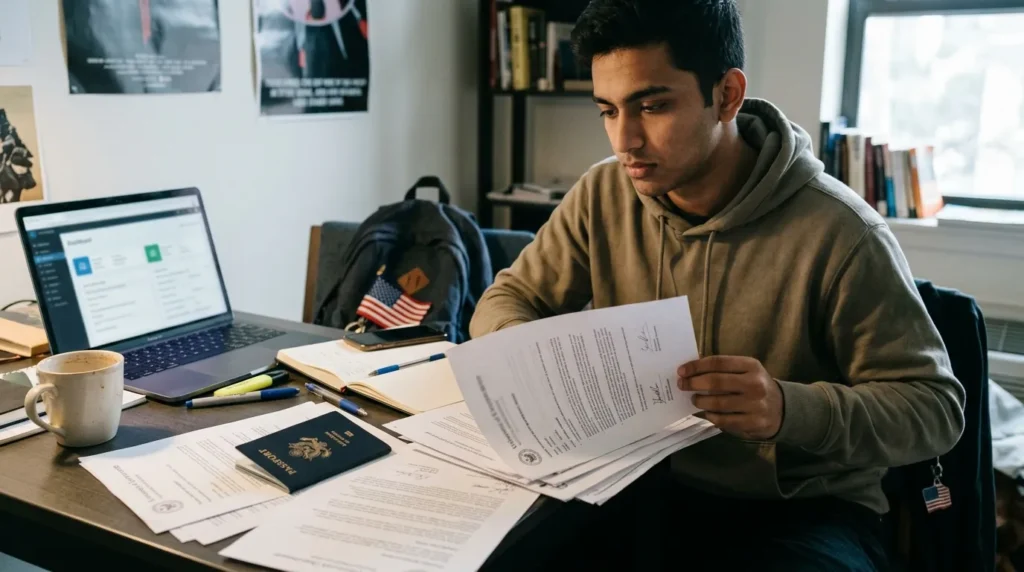
On September 19, 2025, a Presidential Proclamation set a $100,000 payment for employers filing certain new H-1B petitions after September 21, 2025, for workers outside the United States. If you’re changing from F-1 to H-1B status while already in the U.S., the $100,000 payment was not intended to apply to your petition.
The policy has since run into court trouble. In June 2026 a federal court in Massachusetts declared the implementing policy unlawful and vacated it. A new proclamation in September 2026 extended the fee, and on September 30, 2026 a federal court in California vacated and enjoined the policies again, finding they required formal rulemaking (see Forbes’s report). Litigation is likely to continue, so employers and applicants should check the latest USCIS guidance before filing.
Who bears the cost? The employer is the party responsible for any H-1B petition payments, though some employers negotiate to split costs with the employee. The legal uncertainty has made many companies cautious about sponsoring new hires from abroad.
Immigration Visa Fees (Family & Employment-Based)
Family-sponsored and employment-based immigration visas require separate petition and application fees. The sponsoring U.S. citizen or employer files a petition first (I-130 for family, I-140 for employment-based), then the applicant pays the immigrant visa application fee plus a mandatory USCIS immigrant fee of $235 before traveling to the United States. Costs vary by visa category and processing stage, as shown below:
| Fee Type | Amount | Description |
| I-130 Petition (family-based) | $675 | Filed by U.S. citizen sponsor |
| I-140 Petition (employment-based) | $715 | Filed by employer |
| Immigrant Visa Application (family-based) | $325 | Per applicant, State Department |
| Immigrant Visa Application (employment-based) | $345 | Per applicant, State Department |
| USCIS Immigrant Fee | $235 | Paid after visa issuance, before travel |
| Affidavit of Support Review | $120 | Domestic review only |
| Diversity Visa (DV) Registration | $1 | Lottery entry fee |
| Diversity Visa Application | $330 | If selected in lottery |
| Orphan Petition (I-600/I-800) | $775 | Filed by prospective adoptive parents |
Who Pays What? Employer vs. Applicant Breakdown
Visa fee responsibility splits between employer and applicant depending on visa category. Here’s the breakdown:
| Visa Type | Employer / Sponsor Pays | Applicant Pays | Notes |
| H-1B (new hire from abroad) | USCIS petition fees | $205 | The $100,000 payment is currently vacated by courts |
| L-1 (intracompany transfer) | USCIS petition fees + $500 fraud fee | $205 | A $4,500 fee can also apply to certain large employers |
| F-1 (student) | $0 | $185 + $350 SEVIS | Student bears all costs; school doesn’t pay visa fees |
| EB-2/EB-3 (employment-based green card) | I-140 petition ($715) | $345 + $235 = $580 | Immigrant visa applicants are exempt from the integrity fee |
| I-130 (family-based) | $675 petition (U.S. citizen pays) | $325 + $235 = $560 | Sponsoring relative pays petition; foreign national pays visa |
| K-1 (fiancé(e)) | Petition filing fee (U.S. citizen) | $265 | Applicant pays the visa fee |
| B-1/B-2 (tourist) | $0 | $185 | Applicant bears all costs |
Employers bearing H-1B petition costs is standard. Always read your offer letter to see how costs are split, and ask your employer in writing about anything that isn’t clear.
Total Cost of Ownership by Visa Type
Moving beyond visa fees alone, applicants should budget for the full journey. Here are real-world cost scenarios based on official government fees:
F-1 Student Visa:
- Application fee: $185
- SEVIS fee: $350
- Visa integrity fee: not yet collected, not counted
- Consular interview travel: about $200 (varies)
- Total: about $735
If the student’s home city isn’t near a U.S. consulate, add the cost of travel and a night or two of accommodation. Students from rural areas often face higher travel costs because consulates are concentrated in major cities.
H-1B (Specialty Occupation):
- Applicant visa application fee: $205
- Visa integrity fee: not yet collected, not counted
- Applicant travel to consulate: $500–$2,000 (estimate)
- Applicant total: about $705–$2,205
The employer separately pays USCIS petition filing fees, which vary by employer and petition type. The proclamation’s $100,000 payment is not currently enforceable after the court rulings described above, but the situation may change.

EB-2 Employment-Based Green Card:
- Employer I-140 petition: $715
- Immigrant visa application fee: $345
- USCIS immigrant fee: $235
- Medical examination, police certificates and consular travel: costs vary by country
- Government fees: $1,295 (employer pays $715; applicant pays $580)
Timeline matters here. Green card processing can take years. If the applicant remains outside the U.S., they’ll need to travel for a consular interview. If they adjust status within the U.S., they may save on international travel.
I-130 Family-Based Visa (Immediate Relative):
- Petition filing fee: $675 (paid by U.S. citizen sponsor)
- Immigrant visa application fee: $325
- USCIS immigrant fee: $235
- Medical examination, police certificates and consular travel: costs vary by country
- Government fees: $1,235 (sponsor pays $675; applicant pays $560)
Visa Prices by Country (Reciprocity Fees)
The nonimmigrant visa issuance fee (distinct from the $185 application fee) varies by the applicant’s country of citizenship. This reciprocity fee mirrors what the applicant’s home country charges American citizens for the equivalent visa. Many nationalities pay no issuance fee at all, but some countries face additional charges when the visa is issued.
For example, the State Department’s reciprocity table for India lists no fee for B-1/B-2, F-1 and H-1B visas, so an Indian student pays the standard $185 application fee. Other countries have different amounts, and the table also shows visa validity and the number of entries allowed for your nationality.
To find your own amount, look up your passport country in the State Department’s visa reciprocity tables or contact the U.S. embassy or consulate in your home country. You can also use our Visa Cost Calculator to estimate your total.
How to Pay US Visa Fees: Methods & Logistics
Payment methods vary by country. Each U.S. embassy or consulate publishes its own instructions for paying the visa application fee, and you typically pay before your interview. Always follow the instructions on your embassy’s official website, and never pay through unofficial third-party sites.
Common payment options include:
- Online payment: Many countries use an official online payment portal linked to the appointment system.
- Bank deposit or transfer: Some countries use designated banks or payment slips, with instructions on the embassy’s website.
- Payment at the embassy: Some posts accept payment on site. Check whether yours does.
- Local currency vs. USD: Many embassies quote fees in local currency at the embassy exchange rate, which may differ from market rates.
The SEVIS fee (for student visas) is paid separately online through the ICE Student and Exchange Visitor Program, not at the embassy. You’ll receive a SEVIS fee receipt confirming payment; bring this to your consular interview.
Processing and appointment times depend on your location. Check the State Department’s visa appointment wait times tool for your city. Bring your receipt and any documentation proving prior fee payments to avoid duplicate charges.
Common Misconceptions About Visa Prices USA
Misconception 1: “The visa fee is the only cost.”
Reality: Application fees are just the beginning. You’ll also pay SEVIS (if you’re a student), a nationality-based issuance fee in some cases (the new $250 visa integrity fee is not collected yet), and travel costs. For an F-1 visa, the realistic budget is about $635–$1,035strong>, not $185.
Misconception 2: “If my visa is denied, I get the fee refunded.”
Reality: Application fees are non-refundable regardless of approval or denial. Even if consular staff reject your visa at the interview, you don’t recover the $185 (or $205/$265/$315, depending on category). The integrity fee is not collected yet; its refund rules will be set when collection starts.
Misconception 3: “The H-1B $100K fee applies to everyone.”
Reality: The September 2025 proclamation targeted new H-1B hires from abroad, not workers already in the U.S. who change status from F-1 or OPT. Federal courts have also vacated the policy in 2026, so check the latest guidance before assuming any payment is due.
Misconception 4: “My employer always pays visa fees.”
Reality: It depends on visa type. Employers pay the I-140 petition fee for employment-based green cards, but applicants pay the visa application fee. For family visas (I-130), the sponsoring relative pays the petition fee; the applicant pays the visa application fee. Read your offer letter to clarify cost allocation.
Misconception 5: “USCIS and the State Department charge the same fees.”
Reality: USCIS and the State Department are separate agencies with separate fee schedules. USCIS collects petition fees (I-130, I-140) and the immigrant fee; the State Department collects visa application and issuance fees. Your I-140 cost may be $715 (USCIS), but your immigrant visa application fee is another $345 (State Department). Costs are additive, not redundant.
FAQs
How much does a US visa cost in 2026?
Basic application fees range from $185 (tourist, student) to $315 (treaty investor). A new $250 visa integrity fee exists in law for most nonimmigrant visas but is not being collected yet. Some nationalities also pay a visa issuance fee. Students add the $350 SEVIS fee, and immigrant visas have their own fees (see the table above).
Do I pay the H-1B $100,000 fee if I’m already in the US?
No. The proclamation targeted new H-1B petitions for workers hired from abroad. Changes of status from F-1, OPT, or another visa while already in the U.S. were not meant to be covered. Federal courts have also vacated the policy, so check the latest USCIS guidance.
Is the visa application fee refundable if denied?
No. Visa application fees are non-refundable regardless of approval or denial. The SEVIS fee is also non-refundable. Budget accordingly.
What’s included in the $185 F-1 visa fee?
The $185 covers visa application processing and the interview. You’ll separately pay the $350 SEVIS fee and, if one applies to your country, a nationality-based issuance fee. The $250 visa integrity fee is not collected yet.
Who pays the visa fee – employer or applicant?
For H-1B workers, the employer pays USCIS petition fees and the applicant pays the $205 visa application fee. For employment-based green cards (EB-2/EB-3), the employer pays the I-140 petition fee ($715) but the applicant pays visa fees ($345 + $235). For family visas, the sponsoring relative pays the petition ($675); the applicant pays visa fees.
Conclusion
Visa prices USA depend on visa type, country of citizenship, and a fast-changing fee landscape. A student from India pays the standard $185 application fee because the State Department lists no issuance fee for F-1 visas, while a student’s realistic government cost is about $535 once the $350 SEVIS fee is added (the $250 integrity fee is not collected yet). The H-1B $100,000 policy has been vacated by federal courts but remains in legal dispute, employment-based immigrants should budget about $1,295 in government fees, and families sponsoring I-130 petitions should expect about $1,235 before medical and travel costs. Identify your visa category, confirm your country’s reciprocity fee at the State Department website, factor in secondary costs like consular travel, and monitor regulatory updates. Then clarify cost responsibility with your employer or sponsor in writing before committing.
Sources
Last checked: November 2026