Anyone aged 16 or over who wants to study in the United Kingdom (UK) for longer than six months applies for a student visa online, from their home country, after a licensed university or college issues a Confirmation of Acceptance for Studies (CAS). The application costs £558, and the immigration health surcharge (IHS) adds £776 for each year of permission. Applicants from countries on the government’s exemption lists skip the English test and the up-front bank statements, while everyone else submits both. One date changes the maths: living-cost funds rise for applications made on or after 30 November 2026.
Figures below come from GOV.UK, the UK Council for International Student Affairs (UKCISA), the British Council and university visa offices, and were checked on 29 September 2026.
What is the UK Student visa, and who needs one?
The Student visa is the immigration permission that lets a person aged 16 or over study at a licensed student sponsor on a course longer than six months. It replaced the Tier 4 (General) visa, so older guides that use the Tier 4 name describe the same route. Courses of six months or less normally fall under visitor rules, and students under 18 at an independent school apply for a Child Student visa instead.
A student starting a three-year degree in Manchester needs the Student visa, while a student joining a four-month summer programme in Edinburgh does not. Stay length follows the course. Degree-level students aged 18 or over usually receive up to 5 years, and students on courses below degree level usually receive up to 2 years.
Who is eligible for a study visa in the UK?
You are eligible for a study visa in UK when you hold an offer from a licensed student sponsor, can show enough money, meet the English requirement and are 16 or over. Four conditions decide the outcome:
- Offer: a place at a licensed student sponsor, meaning a university or college on the Home Office register
- Money: enough funds for course fees and living costs
- English: proof of your level, unless your nationality or qualifications exempt you
- Consent: written parental permission when you are 16 or 17
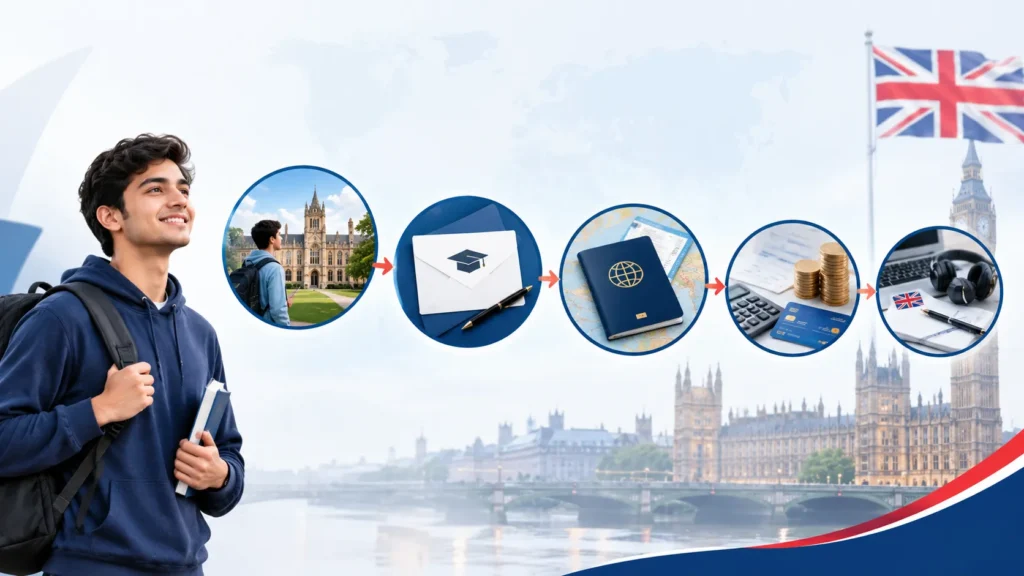
After you accept an offer, the sponsor issues a CAS, a reference number that your visa application depends on. Some universities charge for it, usually £25. Course dates, tuition fees and any amounts you’ve already paid all appear on the CAS, so a wrong date or fee flows straight into the visa decision. UKCISA warns that a CAS can be used only once, which makes an immediate check worthwhile. Apply for a Child Student visa instead if you’re 16 or 17 and want to study at an independent school.
How much does a UK Student visa cost?
A Student visa from outside the UK costs £558, and the healthcare surcharge adds £776 for every full year of permission granted. The table shows each charge:
| Cost | Amount | Rule |
| Student visa application | £558 | One fee per applicant |
| IHS, per year of permission | £776 | Based on permission length, not course length |
| IHS, permission of 6 months or less | £388 | Half the annual rate |
| CAS fee (some universities) | £25 | Set by the sponsor |
Permission length drives the surcharge. UKCISA’s example is a one-year master’s: permission runs for the 12-month course plus 4 months, so the surcharge comes to £1,164 (one full year at £776 plus £388 for the extra 4 months). Add the £558 visa fee and a £25 CAS fee, and the bill reaches £1,747 before tuition, flights or housing.
A three-year degree follows the same logic: 3 years at £776 plus £388 for the extra 4 months gives £2,716. Each family member who joins you pays their own visa fee. If a faster decision is available in your country, the application shows the price.
Which financial documents does UK Visas and Immigration accept?
UKVI accepts personal bank statements, bank letters, certificates of deposit, approved student-loan letters and official financial sponsor letters. The account can be yours, your parents’, your partner’s (if they’re applying at the same time or already hold permission), or a joint account with your name on it. A parent’s account needs two extra papers: your birth certificate and a signed letter from the parent confirming consent.
Other relatives can’t lend their statements. An uncle who funds your studies transfers the money into your account, and the 28-day clock starts only when it arrives. Accepted accounts allow immediate access to the funds, so shares, bonds, credit cards and overdraft facilities fail the test. Institutions must also be regulated and keep electronic records.
Format details matter. Loan letters must be dated within six months of the application, and the loan must come from a national or regional government, a government-sponsored loan company, or an academic loan scheme. A certificate of deposit must be issued within 31 days of applying, with at least 28 days between the deposit and the issue date.
Money held in another currency converts to pounds sterling using the OANDA converter on the application date, according to Newcastle University and Westminster. Documents not in English need a certified translation.
How much money do you need to show?
You need first-year tuition fees (minus anything already paid) plus living costs of £1,529 per month in London or £1,171 per month elsewhere, for up to nine months, on applications made before 30 November 2026. London means the City of London and the 32 London boroughs. The rates rise for later applications:
| Course location | Monthly, before 30 Nov 2026 | 9-month maximum | Monthly, from 30 Nov 2026 | 9-month maximum |
| London | £1,529 | £13,761 | £1,570 | £14,130 |
| Outside London | £1,171 | £10,539 | £1,203 | £10,827 |
Rates and the 30 November change
- GOV.UK still listed £1,529 (London) and £1,171 (outside London) per month on 29 September 2026.
- Higher rates apply from 30 November 2026: £1,570 (London) and £1,203 (outside London) per month.
- The higher amounts come from Statement of Changes HC 584, published on 3 September 2026, as reported by university visa offices and immigration advisers.
- Confirm the rates on GOV.UK before you apply on or after 30 November.
Example 1: London (University of Westminster)
- Tuition: £17,000
- Deposit paid: £5,500
- Outstanding tuition: £11,500
- Total to hold before 30 November: £25,261 (£13,761 living costs + £11,500 tuition)
- Total to hold from 30 November: £25,630 (£14,130 living costs + £11,500 tuition)
Example 2: Outside London (illustration)
- Tuition: £14,000
- Deposit paid: £4,000
- Outstanding tuition: £10,000
- Total to hold before 30 November: £20,539 (£10,539 living costs + £10,000 tuition)
- Total to hold from 30 November: £20,827 (£10,827 living costs + £10,000 tuition)
Timing rules
- Hold the funds for 28 consecutive days.
- Date the closing balance within 31 days of your application.
- GOV.UK’s example: for an application submitted on 1 January, the 28-day period must end no earlier than 1 December.
- One day below the required balance inside that window fails the check.
Shorter courses and accommodation
- Part-months round up: a remaining course of 4 months and 20 days needs 5 months of living costs.
- Money paid to your university for its own accommodation can reduce the living-cost figure by up to one month’s amount, if your CAS records the payment.
- Payments to private landlords don’t count.

Do you have to submit bank statements?
Yes, most applicants submit financial evidence, but nationals of countries on GOV.UK’s differential evidence list do not. The list includes Australia, Canada, China, Japan, Malaysia, Singapore, South Korea, the United Arab Emirates, the United States and EU member states such as France, Germany and Spain. Applicants from India, Pakistan, Nigeria, Bangladesh and Ghana aren’t on it, so they upload evidence with the application.
Listed nationals still meet the money requirement in full. UK Visas and Immigration (UKVI) can request the documents before it decides, and refusal follows if the applicant can’t produce them. A Malaysian applicant holding £25,261 for a London course therefore keeps the statements ready, even though the application doesn’t ask for them.
Sponsors set their own CAS checks. Westminster issues a CAS to listed nationals without reviewing bank documents, and your university may follow a different process, so ask admissions before you assume anything.
Do you need to prove your English?
Yes, most applicants prove their English, but nationals of the countries on GOV.UK’s exemption list do not. The list covers Australia, Ireland, Jamaica, New Zealand, the UK, the USA and other majority English-speaking countries, and Canadian nationals are exempt too. Students on a study abroad programme that forms part of a US university degree skip the requirement as well.
Everyone else has four routes. A UK school qualification such as a GCSE or A level counts, as does a degree awarded by a UK institution. A degree taught in English outside the UK counts after an Ecctis assessment, so a Pakistani graduate with an English-taught bachelor’s degree can apply for an Ecctis code instead of sitting a test. The fourth route is a Secure English Language Test (SELT) from an approved provider, such as IELTS for UKVI.
The required level depends on the course: Common European Framework of Reference for Languages (CEFR) level B2 at degree level or above, and level B1 below degree level. Universities assessing English themselves must still reach an equivalent of B2. Entry requirements are separate, and many universities set higher scores than the visa demands.
How do you apply for a study visa in UK from your home country?
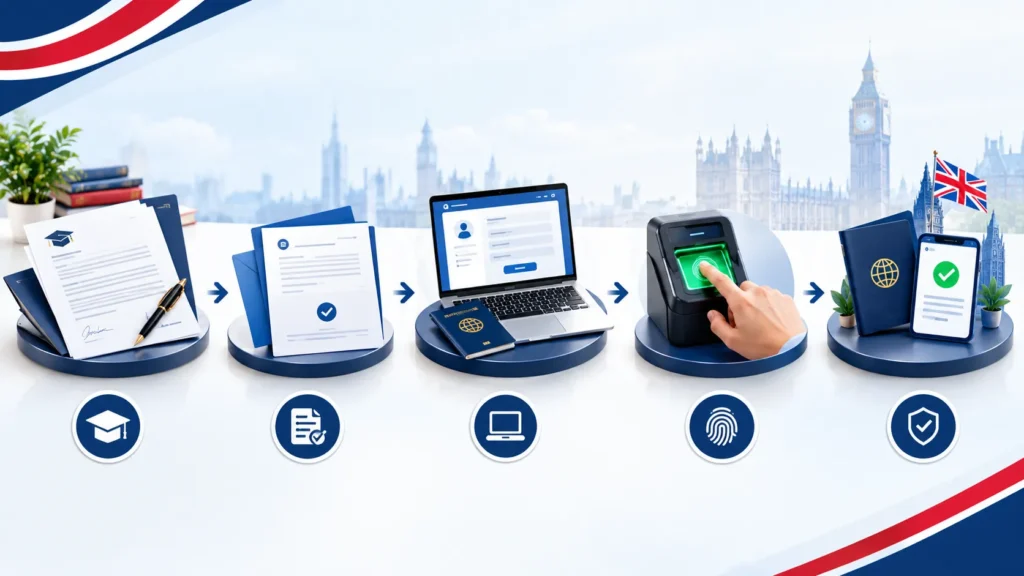
Apply online on GOV.UK after your sponsor issues the CAS, pay the £558 fee and the healthcare surcharge, prove your identity, and wait for the decision. Seven steps cover the process:
- Accept your offer and collect your CAS from the sponsor.
- Gather your passport, your CAS and any required certificates.
- Complete the online application and pay the visa fee plus the IHS.
- Prove your identity through the UK Immigration: ID Check app or at a visa application centre.
- Wait for the decision, which usually arrives within 3 weeks.
- Create a UKVI account and link the travel document you’ll use to enter the UK.
- Travel on or after the start date printed on your visa.
Some certificates take months. Masters-level and higher applicants in certain science and technology subjects need an Academic Technology Approval Scheme (ATAS) certificate, and UKCISA puts processing at 8 to 10 weeks. GOV.UK’s tuberculosis (TB) test page lists which countries require a test. Your application tells you whether you’ll use the app or a visa application centre for biometrics.
Success produces an electronic visa (eVisa), a digital record of your status. The Home Office stopped producing biometric residence permits on 31 October 2024, so no plastic card arrives.
When should you apply, and how long does a decision take?
Apply up to 6 months (about 26 weeks) before your course starts; the decision usually arrives within 3 weeks (21 days). For a course starting on 20 September 2027, the window opens on 20 March 2027. Students who need ATAS, or who must build 28 days of funds, begin earlier than the window suggests.
Travel dates depend on course length. You can arrive up to 1 week before the start date when the course lasts 6 months or less, and up to 1 month before when it lasts longer. Nobody may enter the UK before the start date on the visa, whatever the course calendar says.
Permission also runs past graduation, according to UKCISA:
| Course length | Permission ends |
| 12 months or more | 4 months after the course |
| 6 months to under 12 months | 2 months after the course |
| Pre-sessional course under 6 months | 1 month after the course |
| Other course under 6 months | 7 days after the course |
A course of 12 months or more ending on 30 September 2027 therefore carries permission to 30 January 2028.
What can you do on a Student visa?
You can study, work up to 20 hours per week in term time at degree level (10 hours below degree level), and work full-time during official vacations. Hours count in a Monday-to-Sunday week and can’t be averaged across weeks. Two part-time jobs of 12 hours each total 24 hours and break the 20-hour cap, even though each employer sees only 12.
Other limits apply. GOV.UK bars self-employment, work as a professional sportsperson or sports coach, and claims on public funds such as benefits. Students sponsored for part-time postgraduate study can’t work at all, according to UKCISA. Your eVisa states your exact work conditions, and your university may set stricter limits.
Can you bring your partner or children?
No, most students cannot; only government-sponsored students on courses longer than 6 months and full-time postgraduate students on qualifying courses can. Qualifying postgraduate courses last 9 months or more at RQF level 7 or above. Courses starting on or after 1 January 2024 must be a PhD, another doctorate or a research-based higher degree.
Each dependant must hold their own funds on top of yours: £845 per month in London or £680 per month elsewhere, for up to 9 months, which comes to £7,605 or £6,120. Check those amounts on GOV.UK after 30 November 2026, because sources don’t yet say whether they change. Dependants apply separately with your application number, and their visa ends on the same date as yours.
What happens after your course ends?
You can apply for a Graduate visa from inside the UK, which lasts 2 years if you apply on or before 31 December 2026, 18 months if you apply on or after 1 January 2027, and 3 years for doctorates. A student who finishes a one-year master’s in September 2027 and applies straight away receives 18 months. The application date sets the length, not the course start date.
Other routes exist for students who want to keep studying. GOV.UK allows you to extend a Student visa to continue your course or switch to a different visa from inside the UK. Your eVisa remains the proof of status for every one of those applications.
Why do Student visa applications get refused?
Refusal follows when funds break the 28-day rule, when documents are missing or wrong, or when a credibility interview shows the applicant does not meet the English or genuine-student requirements. The funds rule leaves no margin, since one day below the required balance fails the check. The Home Office can invite applicants to an interview, normally held online, and skipping one without a good reason makes refusal likely.
After a refusal, applicants usually have the right to request an administrative review, and the deadline is strict. Contact your sponsor’s international office or an adviser registered with the Immigration Advice Authority (IAA) straight away. GOV.UK’s find-an-immigration-adviser tool confirms registration. The £558 visa fee isn’t refunded after a refusal, but the healthcare surcharge is refunded in full.
Which visa applies to a course shorter than six months?
Courses of six months or less need no Student visa; you travel as a Standard Visitor, and nationals who don’t need a visa for short stays hold a £20 Electronic Travel Authorisation (ETA). The ETA lasts 2 years or until the passport expires, whichever comes first, and allows multiple trips of up to 6 months each. Nationals who do need a visa apply for a Standard Visitor visa instead.
English-language courses of 6 to 11 months use the Short-term Student visa. An 8-week summer course in London needs the ETA or the Standard Visitor visa, depending on nationality, while a 9-month English course needs the Short-term Student visa. Neither replaces the Student visa for longer study, and visitors can’t work.

FAQs
How much does a study visa in the UK cost?
The application costs £558. The healthcare surcharge adds £776 for each year of permission granted, so a one-year master’s totals £1,722 before any £25 CAS fee.
How long does a UK Student visa decision take?
Applicants outside the UK usually receive a decision within 3 weeks. Applications open 6 months before the course starts, so a September course allows a March submission.
Which countries skip the English test?
Nationals of Australia, Canada, Ireland, Jamaica, New Zealand and the USA, among others, skip it. Everyone else passes a Secure English Language Test at CEFR level B2 for degree study.
Can I work on a Student visa?
Yes. Degree-level students work up to 20 hours per week in term time and full-time during vacations. Courses below degree level allow 10 hours. Self-employment is prohibited.
How much money must I show?
Living costs of £1,529 per month in London or £1,171 elsewhere, for up to nine months, plus unpaid first-year tuition. From 30 November 2026, the rates become £1,570 and £1,203.
Can I stay after graduating?
Yes, through the Graduate visa: 2 years when you apply by 31 December 2026, 18 months from 1 January 2027, and 3 years for doctorates.
Can I bring my partner or children?
No, with two exceptions: government-sponsored students on courses over 6 months, and full-time postgraduate students on qualifying courses of 9 months or more. Newer postgraduate courses must be doctorates or research degrees.
Conclusion
A study visa in UK application rewards early preparation, and the dates are fixed. A course starting on 20 September 2027 opens for applications on 20 March 2027, and any application made on or after 30 November 2026 carries the higher living-cost rates of £1,570 in London or £1,203 elsewhere. Your nationality decides whether you upload bank statements and an English certificate or only keep them ready, but the money and the English level must exist either way. GOV.UK still listed £1,529 and £1,171 on 29 September 2026, so check the page again on the day you apply.