Yes, Pakistani students can study in Germany at public universities with no tuition in most states, but an FSc or HSSC certificate alone usually leads to a Studienkolleg year first. To study in Germany from Pakistan, you need a recognized certificate, English or German language proof, an admission letter, €11,904 in a blocked account and a national visa. The visa fee is €75, and the visa application goes through the German embassy in Islamabad or the consulate general in Karachi.
This guide follows the route in order: which Pakistani qualifications count, which language level applies, how to prepare documents, how to apply, what it costs and what the visa needs. Figures come from DAAD (German Academic Exchange Service), the German mission in Pakistan and the Studienkolleg guide for Pakistani students, and they were checked in October 2026. For the full overview of admission, visa and costs, see our main Study in Germany guide.
Can You Study in Germany From Pakistan Without Paying Tuition?
Yes, Pakistani students pay no tuition at public universities in most German states, the same as German students. Eleven states charge nothing to non-EU students, including Berlin, Hamburg, Hesse and North Rhine-Westphalia.
Baden-Württemberg charges non-EU students €1,500 per semester, and the Technical University of Munich (TUM) charges €2,000 to €6,000 per semester depending on the degree. Every student pays a semester contribution of about €97 to €402 as well. Our guide on how to study in Germany for free lists the fee rules state by state.
Which Pakistani Qualifications Do German Universities Accept?
A four-year bachelor’s degree from an HEC-recognized university gives direct access to a German bachelor’s or master’s program, while FSc or HSSC alone does not. HEC is the Higher Education Commission of Pakistan, and German universities check whether your institution is listed in anabin, the German database of foreign qualifications.
The Studienkolleg guide for Pakistani students describes the pathways like this:
- Matric alone: not enough for any German degree program.
- FSc or HSSC alone: a Studienkolleg (a one-year preparation college) is required before a bachelor’s.
- FSc plus one year at a recognized university: conditional entry at some universities, depending on grades.
- FSc plus two years at a recognized university: direct admission at many universities.
- Four-year bachelor’s from a recognized university: direct admission to a master’s, and universities decide each case.
Anabin rates institutions such as the Lahore University of Management Sciences (LUMS), the National University of Sciences and Technology (NUST) and the Institute of Business Administration (IBA) Karachi at the level that supports direct entry. If your university isn’t listed at that level, the admissions office may send you to a Studienkolleg or ask for extra proof. Check the exact rating for your university and program before you pay any application fee.
Do Pakistani Students Need a Studienkolleg?
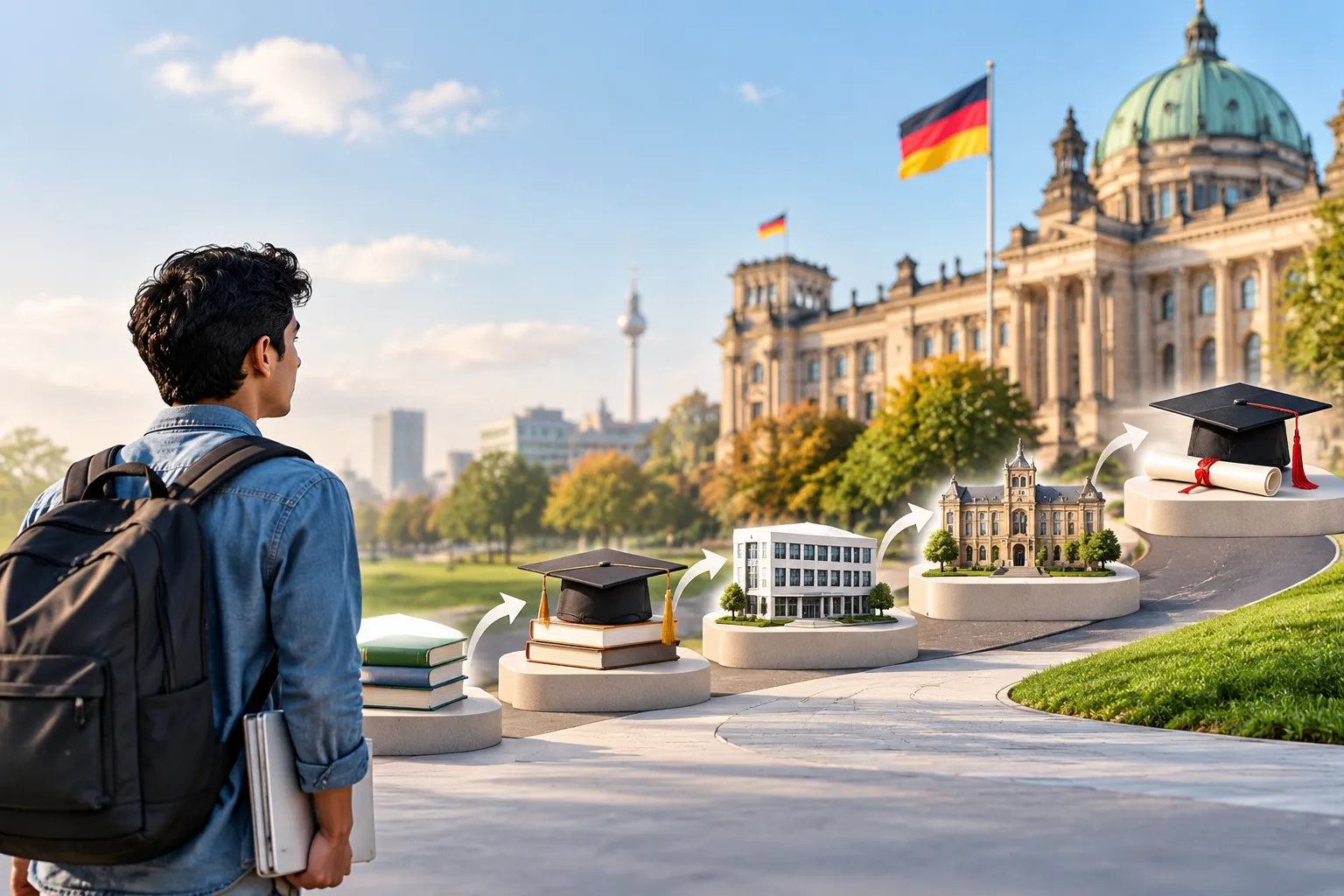
Yes, if you hold only an FSc or HSSC certificate and want a bachelor’s degree, a Studienkolleg year is the standard route. It prepares you for the Feststellungsprüfung, the assessment exam that qualifies you for a German bachelor’s program.
Most Studienkollegs ask for German at level B1, and some give priority to applicants at B2. English-medium schooling doesn’t replace that requirement. A student from Lahore with an FSc in pre-engineering, for example, would complete A2 and B1 German courses first, apply to a Studienkolleg and then start a technical course after passing the exam. Applicants with two years of university study at a recognized institution can often skip this step, so compare the rules of your target university with your transcripts.
Which Language Level Do You Need to Study in Germany From Pakistan?
English-taught programs ask for IELTS or TOEFL, and German-taught programs usually ask for level C1 in German. The Common European Framework of Reference (CEFR) ranks language skill from A1 to C2, and TestDaF or DSH are the usual German tests for C1.
English-taught master’s programs are common in engineering, computer science, business and data science, and the program page lists the exact English score. Some universities accept a previous degree taught in English instead of a test. The DAAD database filters programs by teaching language, so you can list English-taught options in one search. The German visa officer doesn’t require German for an English-taught program, but A1 or A2 German makes daily life easier in your first months.
How Do You Prepare Your Pakistani Documents?
Prepare certified copies of your certificates and transcripts, a passport valid for at least 12 months, a CV, a motivation letter and a language certificate. Most universities want certificates verified by the issuing board, HEC or both, and the university’s admission page names the exact format.
The German mission offers certified copies of study documents. The embassy in Islamabad needs an online appointment, while the consulate general in Karachi serves walk-ins from Monday to Thursday between 1:30 pm and 2:30 pm. The mission certifies a maximum of four sets of copies per person per day, and one set can be free when you show proof of intent to study, such as an email from the university. Pakistani documents such as birth certificates can’t be attested by the embassy.
Pakistan has no sworn translators. If a document needs a certified translation, you find a translator in the databank of the German federal states, and the embassy doesn’t guarantee the quality or cost of the work.
Which German Mission Handles Your Application?
Applicants from Sindh and Balochistan apply in Karachi, and applicants from every other region apply in Islamabad. Your place of residence decides the mission, so register on the right Consular Services Portal.
| Mission | Region served | Document services |
| German Embassy Islamabad | Islamabad Capital Territory, Punjab, Khyber Pakhtunkhwa, Gilgit-Baltistan, Azad Jammu and Kashmir | Certified copies by online appointment |
| German Consulate General Karachi | Sindh, Balochistan | Certified copies without appointment, Monday to Thursday, 1:30 pm to 2:30 pm |
| Honorary Consul in Lahore | Lahore and nearby areas | Attestation of study documents for local residents |
How Do You Apply to a German University From Pakistan?
Pick a program in the DAAD database, check the entry rules, apply before the deadline and request the visa after you receive the admission letter. Seven steps cover the process:
- Search programs by subject, degree level and teaching language in the DAAD database.
- Compare the entry requirements with your certificates and your anabin rating.
- Collect transcripts, certificates, passport copy, CV and language results.
- Apply directly or through uni-assist, the service many universities use to evaluate international certificates.
- Accept the offer and complete enrollment.
- Open a blocked account and buy health insurance.
- Register on the Consular Services Portal, upload your documents and wait for the appointment notice.

Many universities close winter semester applications on July 15 and summer semester applications on January 15, and master’s programs often close earlier. A student planning the 2027 winter semester from Karachi should order certified copies and book the language exam by early 2027. APS (the Academic Evaluation Centre certificate) isn’t required for Pakistani applicants, unlike applicants from India, China and Vietnam.
How Much Does It Cost to Study in Germany From Pakistan?
Plan for about €10,100 per year in living costs, plus the €75 visa fee and a semester contribution of €97 to €402. DAAD puts average student spending at €842 per month, covering rent, food, health insurance, phone and study materials.
Statutory student health insurance costs about €141 to €146 per month in 2026, and that amount sits inside the €842 average. Language courses, a Studienkolleg year, flights and the first month’s rent come on top. The visa asks for more than a typical student spends, since authorities want proof of €992 per month, which equals €11,904 for twelve months.
Can Pakistani Students Work While Studying in Germany?
Yes, students from outside the EU can work 140 full days or 280 half days per year. A shift of up to four hours counts as a half day, so 280 four-hour shifts fit inside the limit.
Student assistant jobs at your university have no day limit, but the foreigners’ office (Ausländerbehörde) needs to know about them. Freelancing and self-employment require its permission. Part-time income helps with rent and food, but it can’t replace the blocked account that the visa requires.
Which Scholarships Can Pakistani Students Apply For?
DAAD, the Deutschlandstipendium and political foundation scholarships support international students, and eligibility depends on the program. The DAAD scholarship database filters funding by home country, degree level and subject.
DAAD Study Scholarships open on June 1, the Heinrich Böll Foundation accepts applications from January 15 to March 1 and from July 15 to September 1, and the Deutschlandstipendium runs through your university. Confirm every date on the funder’s site, because windows move from year to year.
What Mistakes Delay Applications From Pakistan?
Applying to the wrong mission, uploading incomplete documents and ignoring the Studienkolleg rule cause most delays. Each one has a simple fix:
- Wrong mission: a Sindh resident who registers in Islamabad risks rejection, so match your address to the region table above.
- Incomplete uploads: past degree certificates are mandatory, and a missing transcript sends the file back.
- Skipping the anabin check: an FSc holder who applies for a bachelor’s directly gets rejected, so confirm the entry route first.
- Paying agents for free steps: third-party providers charge service fees, while a search in the DAAD database costs nothing.
How Does the Student Visa Application Work in Pakistan?
Applicants register on the Consular Services Portal, upload documents, and receive an appointment after an officer screens the file. Past degree certificates and transcripts are mandatory, and incomplete files stay on hold.
The long-term visa fee is €75, paid in Pakistani rupees in cash at the counter of the embassy or consulate general. Documents usually include the passport, the admission letter, language proof, a motivation letter, biometric photos, health insurance and proof of funds. Appointment queues can be long, so start the process as soon as you hold the admission letter. Our Germany student visa guide lists the full document set, and the Visa Cost Calculator helps estimate your total fees.
Proof of funds has three options. A blocked account (Sperrkonto) at a provider such as Expatrio or Fintiba holds the full amount and releases €992 per month after you arrive. A declaration of commitment (Verpflichtungserklärung) from a person living in Germany is the second option, and a full scholarship from a recognized body is the third.
FAQs
Is it free to study in Germany from Pakistan?
Yes, at public universities in most states. Baden-Württemberg and TUM charge non-EU students, and every student pays a semester contribution of €97 to €402.
Can you study in Germany after FSc?
Yes, but you usually attend a Studienkolleg first. Direct entry needs FSc plus about two years at a recognized university, according to the Studienkolleg guide for Pakistani students.
Do Pakistani students need IELTS for Germany?
Yes, for most English-taught programs. Some universities accept an earlier English-taught degree, so read the requirements on the program page.
Is APS required for Pakistani students?
No. APS applies to applicants from India, China and Vietnam, and Pakistani applicants send their documents straight to the university or uni-assist.
How much is the German student visa fee in Pakistan?
The long-term visa fee is €75, paid in Pakistani rupees in cash at the embassy in Islamabad or the consulate general in Karachi.
How much money do you need in a blocked account?
You need €11,904 for twelve months, which equals €992 per month, held in a blocked account or covered by another accepted proof.
Can you work part-time as a Pakistani student in Germany?
Yes, up to 140 full days or 280 half days per year. Student assistant jobs at the university carry no day limit.
Which embassy do you apply to?
Residents of Sindh and Balochistan apply in Karachi, and residents of all other regions apply in Islamabad.
Conclusion
Study in Germany from Pakistan starts with the right entry route: FSc holders attend a Studienkolleg, and holders of a four-year bachelor’s from a recognized university apply directly for a master’s. Pay no tuition in most states, budget about €10,100 per year for living costs and prove €11,904 for the visa.
Check your anabin rating, choose a program in the DAAD database, prepare certified documents and register with the correct mission. The German visa fee in Pakistan is €75.