Planning a trip to the United States? You’re probably wondering whether you actually need a visa, how much it’ll cost, and when you can expect approval. This guide answers those questions with real numbers, honest timelines, and strategies from people who’ve navigated the process successfully. Whether you’re visiting for tourism, business, or to see family, you’ll find exactly what you need to move forward—no legal jargon, no guesswork, just straight facts.
What Is an Entry Visa to the US?
An entry visa to the US is an official document that allows foreign nationals to travel to the United States and request admission at a port of entry. Without one, most non-citizens can’t legally board an aircraft or cross a land border headed to American soil. Getting approved involves submitting forms, attending an interview at a US embassy, and convincing a consular officer that you have legitimate reasons to visit and plan to leave when your authorized stay ends.
The process sounds intimidating because it involves immigration law, federal forms, and gate-keepers with final say over your acceptance. But the mechanics are straightforward once you understand the categories, costs, and timeline. This guide walks you through every step—from figuring out which visa type you need to recovering if your application gets denied. Whether you’re planning a vacation, visiting family, or attending business meetings, you’ll find the specific information and numbers you need.
ENTRY VISA TYPES: WHICH ONE FITS YOUR PURPOSE?
The US government issues roughly 185 visa categories, split into nonimmigrant visas (temporary) and immigrant visas (permanent). Most visitors choose nonimmigrant visas—they’re faster and don’t require employer sponsorship.
For tourism and business: The B-2 visa covers tourism, leisure, and family visits. The B-1 visa handles business trips. Many applicants get a combined B1/B2 visa for both purposes. Customs and Border Protection officers typically authorize stays up to 6 months.
For students and workers: F-1 visas cover academic programs. H-1B visas are for specialty occupations. L-1 visas cover intracompany transfers. All require documentation beyond tourist applications.
For permanent residence: Immigrant visas (green card visas) suit family members of US citizens, diversity lottery winners, and trafficking survivors. USCIS conducts lengthy background investigations and reviews public charge rules—ensuring applicants won’t burden the government.
An entry visa to the US is the standard path for most first-time visitors. Citizens of 42 Visa Waiver Program countries—Australia, Japan, Germany, France, South Korea, United Kingdom, and others—skip the visa and use ESTA (Electronic System for Travel Authorization) instead for tourism or business stays up to 90 days. Canada and Bermuda citizens are visa-exempt.
ENTRY VISA REQUIREMENTS & ELIGIBILITY
Applying for an entry visa to the US requires three core things: a valid passport, proof of funds, and ties to your home country.
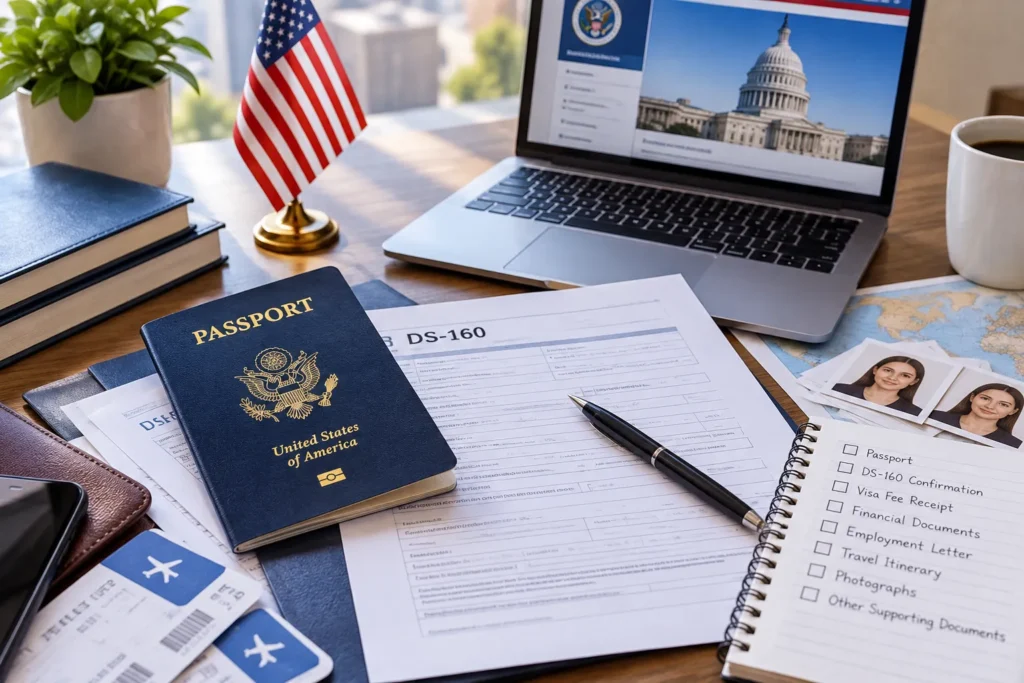
Valid passport: Your passport must have at least six months of validity beyond your planned stay and contain blank pages for the visa stamp. Renew it before applying if it’s expiring within the next few months—the State Department won’t issue a visa in an expiring passport.
Proof of financial ability: You don’t need to be wealthy. Consular officers understand different economic circumstances. Bring three recent monthly bank statements or employment letters showing income. If family or friends are sponsoring your visit, they can provide an Affidavit of Support (Form I-864 for immigrants, or a simple letter for tourists). Self-employed applicants should bring tax returns from the past two years; retired or unemployed applicants bring Social Security or pension statements. The dollar amount required depends on your visit length and activities.
Ties to your home country: Consular officers need proof you’ll return after your stay. Ties include employment (job contract), property ownership (deed or lease), family (spouse or school-age children), or educational enrollment. A Brazilian with business registration in São Paulo, an Indian citizen with a Delhi employment contract, or a Nigerian woman with school-age children all show strong ties. If you’re between jobs or haven’t owned property, write a letter explaining your plans and what you’re returning to. Honesty about temporary circumstances beats silence.You can also review our Visa Eligibility Checker before starting your application.
ENTRY VISA COSTS: WHAT YOU’LL ACTUALLY PAY
An entry visa to the US application costs $185 for most visitors. This fee is nonrefundable even if your application is denied. You pay it when you submit your DS-160 form online before scheduling your interview.
Many countries charge reciprocity fees on top of this—extra charges based on what their governments charge Americans trying to enter. Australian citizens pay $20 more; British nationals pay another £20 (~$25 USD). Mexican citizens pay a reciprocity fee of $22. If you’re from a country without reciprocal fees (like Canada), you pay only the base $185. Check the State Department’s reciprocity table for your nationality to find your exact amount.
You’ll also pay for a visa photo if you don’t have a recent one meeting US specifications (2 inches by 2 inches, white background, head filling 50 percent of the frame). A visa photo costs $8–$15 at most photo shops; $2–$3 if you use a passport photo machine.
If you’re using a courier service to submit your passport instead of visiting the embassy in person, expect $25–$75 depending on your country and service level. Not all embassies offer courier services; check yours.
Once approved, some applicants use expedited delivery to get their passport back with the visa stamp faster. Expedited shipping runs $30–$50.
Here’s a realistic total for a Brazilian applying for an entry visa to the US: $185 application + $50 reciprocity + $12 photo + $50 courier + $40 expedited shipping = $337. An Australian citizen: $185 + $20 reciprocity + $10 photo = $215. A Canadian: $185 + $0 reciprocity + $10 photo = $195. These aren’t the only costs (embassy appointment fees exist in some countries), but they cover the main ones.
HOW LONG DOES AN ENTRY VISA TAKE? TIMELINE REALITY
Most people applying for an entry visa to the US wait 3 to 6 weeks from interview to approval, though timing varies significantly by embassy. London and Berlin often approve visas within 2–3 weeks. Manila, Mexico City, and Mumbai might take 6–8 weeks during peak season (June–August, December, and March–April).
Plan to apply at least 8–10 weeks before you need to travel. Rushing signals red flags to consular officers and invites scrutiny. The State Department publishes current visa wait times for each embassy on its website—search “visa wait times [your city]” to find your specific backlog. Regional variation is substantial: an applicant in Atlanta might wait 10 days, while the same application in Houston could take 3 weeks.
Expedited appointments exist in some locations for $10–$25 extra, but they only move you up in the interview queue—they don’t accelerate the approval decision itself. You still wait for results.
THE ENTRY VISA APPLICATION PROCESS: STEP BY STEP
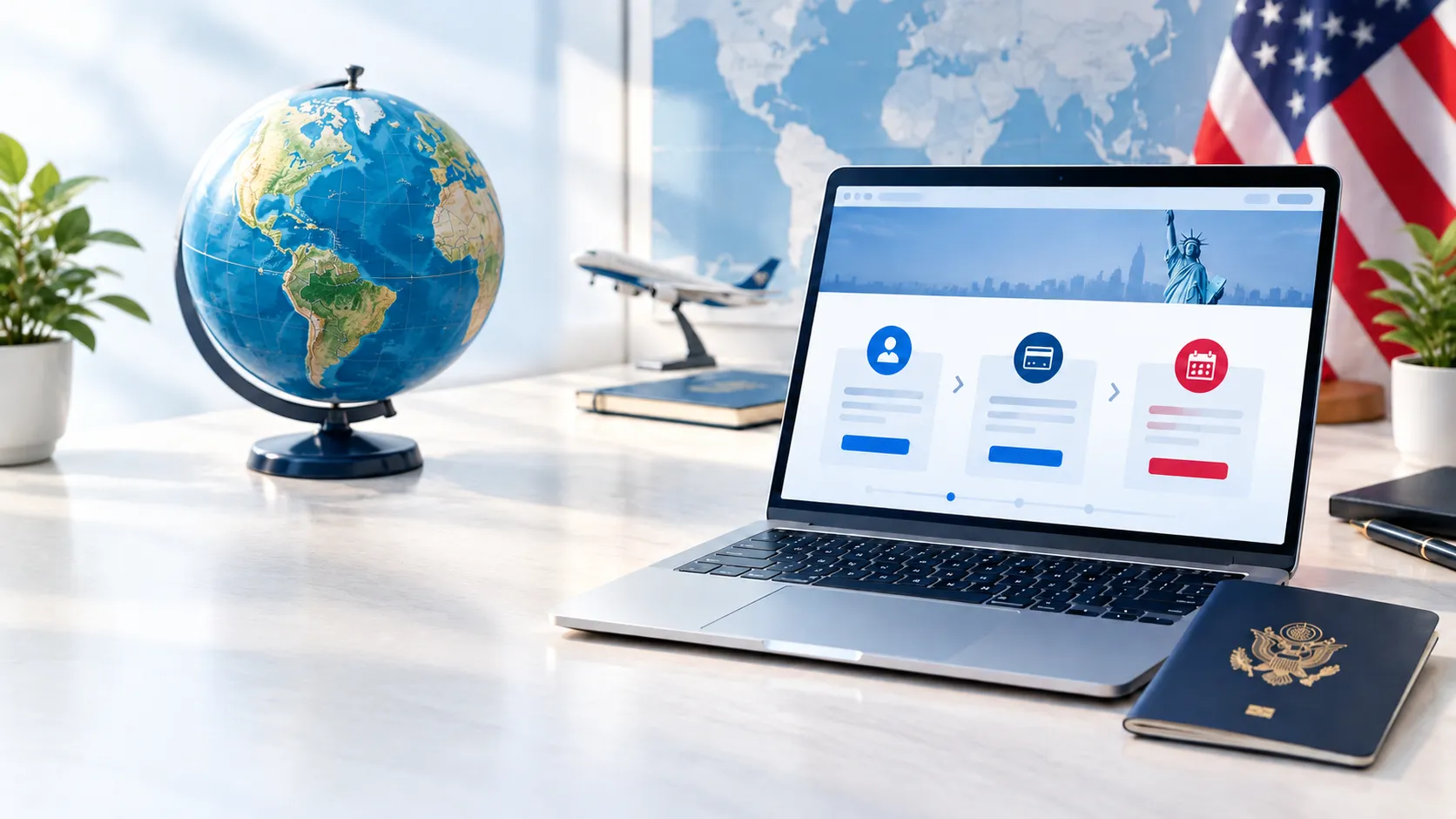
Applying for an entry visa to the US follows five main steps:
Step 1: Fill Out DS-160 Online Create an account on the State Department’s DS-160 portal and complete the nonimmigrant visa application form. Enter personal details, passport information, travel history, employment, family, and your visit purpose. Upload a recent digital photo (2 x 2 inches, white background, head centered). Budget 20–30 minutes.
Step 2: Get Your Confirmation Number After submitting the DS-160, you’ll receive a confirmation number. Save and screenshot it—you’ll need it to schedule your interview.
Step 3: Schedule Your Visa Interview Book your visa interview appointment at your nearest US embassy or consulate through the embassy’s website or appointment scheduler. Select your interview date, pay any fees, and receive your appointment confirmation email.
Step 4: Gather Documents & Attend Interview Bring your passport, DS-160 confirmation page, appointment email, and supporting documentation: bank statements (3 months minimum), ties documentation (employment letter, property deed, marriage certificate, school enrollment, lease), and travel itinerary.
Interviews are brief—typically 3 to 5 minutes. The consular officer will ask why you’re visiting, how long you’re staying, who’s paying, and what you do for work. Answer directly without volunteering extra information.
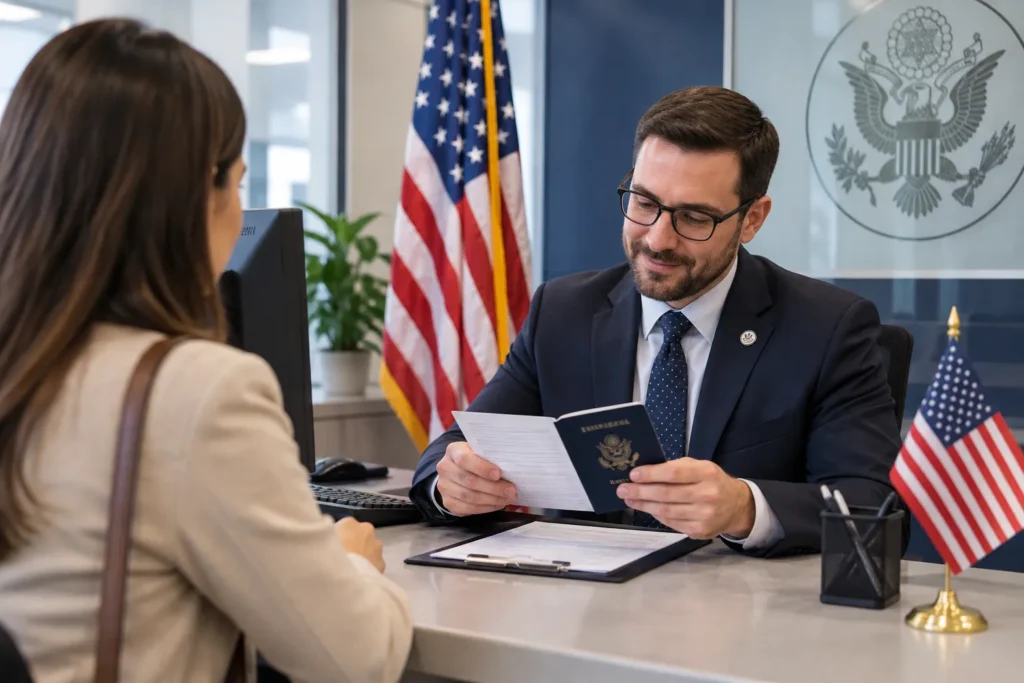
Common interview questions:
- “Why visit the United States?” → Give your specific reason
- “How long will you stay?” → State a number: “Three weeks”
- “Who’s paying?” → “My employer,” “My savings,” or “My family”
- “Will you return home?” → Say yes and explain why (job, family, property)
- “Been to the US before?” → Answer truthfully
Step 5: Receive Your Decision Approvals often happen same-day. The officer hands back your passport with the visa stamp inside. Denials come with written explanation. Requests for more information mean the embassy is conducting 221(g) administrative processing—you’ll wait 2–4 weeks while they verify your background.
Your visa stamp is your proof you can travel. The immigration officer at the airport or border will scan your passport and confirm the visa in the system
WHY ENTRY VISAS GET DENIED & HOW TO RECOVER
Denial Rates Consular officers reject 15–30% of applicants depending on nationality. Nigerian nationals face ~45% denial rates, while Japanese citizens experience ~5% rates. Even wealthy, well-documented applicants get denied for specific reasons.
Three Main Denial Types:
- Section 214(b) Denial (Most Common) This law presumes every nonimmigrant visa applicant intends permanent US residence unless proven otherwise. Officers reject you if they doubt you’ll return home. A 22-year-old applying alone from a high-overstay country, unemployed, with no family or property at home raises red flags. A 45-year-old with school-age children at home, employment contract, and apartment lease looks different.
How to Recover from 214(b):
- Reapply at the same embassy with stronger ties documentation
- Get employer letters confirming job security and approved vacation time
- Gather family letters confirming dependents or property responsibilities
- Show bank statements proving regular savings (signals stability)
- Bring international travel records proving you always returned home on time
- Simple life changes help: marriage, new job, home purchase change officer perception
- Section 221(g) Denial (Administrative Processing) The embassy needs more time to investigate your background—security checks, name checks, or document verification. This is not a rejection; it’s a hold. You’ll wait 2–4 weeks. Most 221(g) cases eventually approve. Don’t reapply unless the embassy asks.
- Criminal History & Security Grounds (Hardest to Overcome) Felony conviction, fraud, or terrorism-related activity makes you inadmissible. A US immigration attorney can petition for a waiver under Section 212(d)(3), but waivers cost $2,000–$5,000 in legal fees with no guarantee of success.
Recovery Timeline For simple 214(b) denials, reapply 2–3 months later. Officers see you’re serious, and you’ve had time to gather stronger evidence
ESTA VS. ENTRY VISA: DO YOU REALLY NEED ONE?
| Factor | ESTA | Entry Visa |
| Who qualifies | Citizens of 42 Visa Waiver Program countries (Australia, Japan, Germany, France, South Korea, UK, etc.) | Citizens of all other countries |
| Application | Online form (10 minutes) | Online + in-person interview at embassy |
| Cost | $14 | $185+ (plus reciprocity fees) |
| Processing time | Minutes to days | 3–6 weeks |
| Stay duration | Up to 90 days | Up to 6 months (varies by visa) |
| Interview required | No | Yes |
| Ties documentation | Not required | Required |
| Work allowed | No | Depends on visa type |
| Study allowed | No | F-1 visa only |
| Approval duration | 2 years | Varies (up to 10 years for some) |
| Appeal process | Limited; must apply for visa instead | Full explanation and appeal options |
Quick Decision Guide: Citizens of Visa Waiver Program countries should use ESTA if staying 90 days or less, traveling on a commercial airline, and won’t work or study. Choose an entry visa to the US if you need to stay longer than 90 days, plan to work, want to study, or prefer detailed approval/denial documentation. ESTA is cheaper and faster, but visas offer more flexibility and clearer appeal options if rejected.
COUNTRY-SPECIFIC VISA GUIDANCE
- Canada & Bermuda are visa-exempt: Canadians enter the US indefinitely for tourism and business on a valid passport. Bermudians can stay up to 180 days. Neither needs a nonimmigrant visa.
- Mexico has special rules: Most Mexican citizens need a visitor visa. However, government officials qualify for visa-free travel, and Mexican nationals can apply for a Border Crossing Card (simplified visa for land travel between US and Mexico).
- Regional processing times vary dramatically: London Embassy approves tourist visas in ~5 business days. Mumbai Consulate takes 6–8 weeks. Manila, Bogotá, and Rio de Janeiro have longer queues. Check your specific embassy’s website before applying.
- Smaller cities require planning: If applying from a city without a US embassy or consulate, confirm whether you must travel to a capital city for your interview or if a consular agent can conduct it remotely.
- Premium expedited services exist at some embassies: UK, Australia, and Canada offer prioritized interview slots costing $10–$25 extra. Most US embassies in Latin America don’t offer this. Ask your embassy before assuming you can pay to skip the queue.
FREQUENTLY ASKED QUESTIONS
How much does an entry visa to the US actually cost me?
Base application fee is $185 USD, nonrefundable. Country reciprocity fees add $0–$50. Photos, couriers, and expedited shipping total another $50–$100. Your nationality determines your exact total, ranging from $185 to $335.
Can I work in the US on a B-2 tourist visa?
No. B-2 visas strictly prohibit employment. Working illegally triggers deportation and permanent inadmissibility lasting 10+ years. Choose an appropriate work visa category (H-1B, L-1, E-2) if employment is your actual purpose.
What happens if my entry visa application gets denied?
You’ll receive written explanation stating the reason. Most 214(b) denials succeed on reapplication when you bring stronger documentation proving home country ties. Administrative 221(g) cases typically resolve within four weeks without requiring a new application.
Can I extend my stay after my entry visa expires?
File Form I-539 with USCIS before your authorized departure date. Extensions grant six-month increments for most categories. B-2 tourists sometimes receive one extension; other visa types follow different rules. Plan ahead—last-minute requests rarely succeed.
Do I need an entry visa if I’m just transiting through the US to reach Canada?
Yes. Canada-bound passengers stopping at US airports must hold a valid visa or ESTA, even without leaving the terminal. The only exception: direct flights from your home country to Canada with zero US connections.
CONCLUSION
Getting an entry visa to the US takes planning, costs $185 to $335, requires documents proving your ties to home, and typically takes 3 to 6 weeks from interview to approval. The process protects US security by verifying your identity and intention to return home. Officers aren’t trying to reject you—they need to confirm your story matches what you’ve written on the DS-160 form and what your documents show. Be honest, bring everything requested, and answer interview questions directly without volunteering extra details.
If denied, understand the specific reason and reapply with stronger evidence. The second application succeeds more often than the first because you’ve learned what the officer doubted and you’ve brought proof addressing that doubt. Your passport with the visa stamp is your permission to travel and request entry. Nothing else matters once you have it.