
A water damaged passport usually needs to be replaced by applying in person, because the State Department says airlines may deny boarding if a passport is damaged and tells you to bring the damaged book, a signed statement and Form DS-11. Ordinary wear and tear does not count.
A passport that has been through a washing machine, a flooded bag or a leaking suitcase can look fine once it dries, or it can come out stained, curled and stuck together. The rules do not give a simple wet-or-dry test. That leaves travelers guessing. This guide explains what counts as damage, when to replace a passport, how the in-person replacement works, how disaster fee waivers work, what to do abroad, and how to avoid scams. The official parts come from the State Department’s passport FAQ, last updated on 18 May 2026, its page on replacing a passport after a disaster, last updated on 4 May 2026, and its renewal overview page, last updated on 16 July 2026. Fees, timelines and a few water-specific details come from three travel and visa service pages, which are secondary sources and disagree in places. Confirm fees and timing on travel.state.gov before you apply. For the full overview of the process, start with our US passport guide.
What Counts as a Water Damaged Passport?
Stains, mold, curled or stuck pages, ink that runs and a warped cover count as damage, while a small bend or folded page does not. The State Department’s disaster page gives the clearest official list.
That page says normal wear, such as folded pages or a small bend, does not count as damage. It says damage includes stains, mold, significant tears, unofficial markings on the data page, missing or torn-out visa pages and hole punches. A separate FAQ entry says not to replace a passport if there is normal wear and tear, but it does not define damaged or mutilated and has no water entry of its own.
The secondary sources fill the gap in different ways:
- AFAR (2024): lists water damage and humidity-caused curling among unacceptable damage, along with significant tears, unofficial markings, a loose cover and a damaged chip.
- Travisa (2026): lists water damage, minor or major, as a condition that makes a passport likely to be unacceptable.
- PhotoAiD (June 2025): says significant liquid damage needs a new application, but if the water caused no significant change the passport can simply be dried.
Those sources disagree on minor exposure, so we cannot give you a firm line. A passport that got a little damp and looks normal sits in a gray area. One with stains, mold, warped pages or smeared ink does not.
Which Situation Needs a Replacement?
Replace the passport if water left a visible mark, shape change or smell, and keep it only if it dried with no change at all. The table summarizes a safe approach based on the sources.
| What happened | Likely result | Safer step |
| Briefly damp, dried flat, no marks | Gray area. PhotoAiD says it may be dried | Inspect carefully and consider replacing before a big trip |
| Stains or curled edges | Counts as damage per the State Department list and secondary sources | Replace |
| Mold or musty smell | Mold counts as damage per the State Department | Replace |
| Pages stuck or ink smeared on the data page | Likely unreadable for scanners | Replace |
| Warped cover or loose binding | Secondary sources list this as damage | Replace |
| Chip not working | Secondary sources list it as damage | Replace |
| Lost or damaged in a listed disaster | Fee waiver may apply | Use the disaster process |
The table is not an official test. It shows how the sources point. When you are unsure, the cost of an extra application is small compared with being turned away at an airline desk. Our passport card vs book guide explains why the card does not solve overseas travel.
Can You Still Travel With It?
The State Department warns that airlines may deny you boarding or you could face difficulties abroad if your passport is damaged. It advises you to apply in person for a new one.
The FAQ does not say whether a damaged passport stays valid, and it does not give a list of what each airline will accept. Travisa warns that authorities could deny entry, detain the traveler or send them home, and says the standards for a working passport are pretty high. A water damaged passport can look acceptable to you and still fail a scanner or a careful agent. Do not travel on a passport you doubt, and do not wait for the airport to find out. If you need help judging a trip with a short timeline, our passport 6 month rule guide lists the other checks that can stop you at the gate.

What Should You Do Right After It Gets Wet?
Open the passport gently, let it air dry flat away from heat, and avoid forcing stuck pages apart. This is general handling advice, not an official procedure.
The State Department pages we reviewed give no drying steps. The following is common sense and should be treated that way:
- Remove the passport from wet clothing or bags as soon as you can.
- Open it carefully if the pages are not stuck, and let it air dry.
- Keep it away from heaters, ovens and hair dryers that can warp the cover.
- Do not rip pages apart or peel the laminate.
- Photograph the data page, the cover and any damage while it is fresh.
- Do not repair it with tape or glue.
AFAR says any physical alteration can make a passport invalid and advises against repairing it yourself. If the passport dries with marks or warping, treat it as damaged and replace it.
How Do You Replace a Water Damaged Passport?
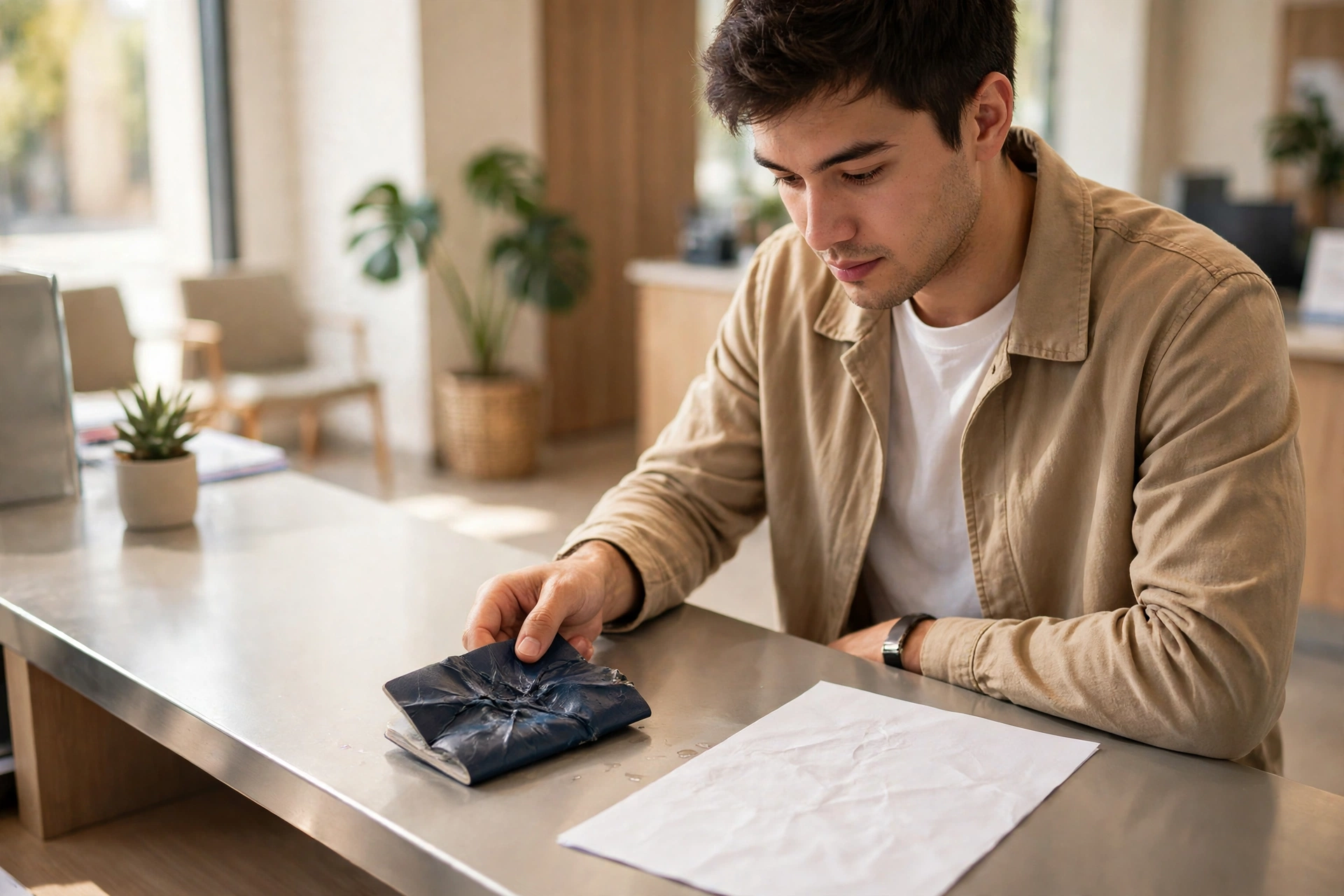
Apply in person with Form DS-11 and bring the damaged passport, a signed statement and the usual documents. The State Department’s FAQ lists those three items.
The FAQ says to submit the damaged passport, a signed statement describing the damage, and Form DS-11 with supporting documents, a photo and fees. The statement should explain the damaged condition of your passport book or card. Secondary sources add practical items:
- Proof of US citizenship with a photocopy.
- A government photo ID with a photocopy.
- One 2 by 2 inch passport photo. See our passport photo requirements guide.
- Fees paid by check or money order for the State Department fee and a separate execution fee.
Do not sign the DS-11 until the agent tells you to. Our passport acceptance facility guide explains the visit, and our passport application guide walks through the form. The State Department renewal page does not say that damaged passports can be renewed by mail, so do not assume a mail renewal works.
What Should the Signed Statement Say?
Keep it short: name, date of birth, passport number if you know it, what happened, when, and a signature. The FAQ asks only for a signed statement describing the damage.
A useful statement answers these points:
- How the passport got wet, such as a spill, flood or rain.
- When and where it happened.
- What condition it is in now, such as stained pages or a warped cover.
- That you are submitting the damaged passport with your application.
Sign in blue or black ink. PhotoAiD describes the letter as addressed to the State Department. Avoid long stories. Our lost passport replacement guide has a different path for passports that are gone, not damaged.
What Does It Cost and How Long Does It Take?
Secondary sources put the replacement at about $165 for routine service, plus $60 for expedited service, but the State Department pages we reviewed do not list the amounts. Check the fee page before you apply.
The figures from the sources are:
- Application fee for an adult book: $130 (AFAR and PhotoAiD).
- Execution fee: $35 (AFAR and PhotoAiD).
- Expedited service: $60 extra (AFAR and PhotoAiD).
- Routine timing: 6 to 8 weeks per AFAR, or 6 to 9 weeks per PhotoAiD.
- Expedited timing: 2 to 3 weeks per AFAR, or 3 to 5 weeks per PhotoAiD.
The timings differ between sources and likely reflect different dates, so use the current State Department estimate. Our how much is a passport and how long does it take to get a passport guides track the latest numbers. If your trip is close, read our expedited passport and passport office guides.
Does a Disaster Change the Rules?
Yes, if your passport was lost or damaged in a disaster listed by the State Department, you may qualify for a fee waiver. The waiver covers the application fee for three years and the file search fee for 18 months.
The disaster page explains the program in detail:
- Forms: Form DS-5504 for the replacement application, a new passport photo and Form DS-64 to report the loss.
- What to write on DS-64: The name of the disaster, the address where the passport was lost, the approximate date and a statement that other sources will not reimburse the fees.
- Travel in more than three weeks: Mail the forms and photo to the address on page 2 of DS-5504.
- Travel in less than three weeks: Do not mail the application. Make an appointment at a passport agency or center within two weeks of your trip.
- Not eligible: You have never had a passport, you lost an expired passport, or the event is not on the list.
The page says passport fees cannot be reimbursed by other sources, so insurance will not pay the fee. It lists qualifying disasters from 2023 through 2026, and some file search waivers are marked no longer valid. Check the live list before you rely on it. If the event is not listed, use the normal in-person process described above.
What If It Happens Abroad?
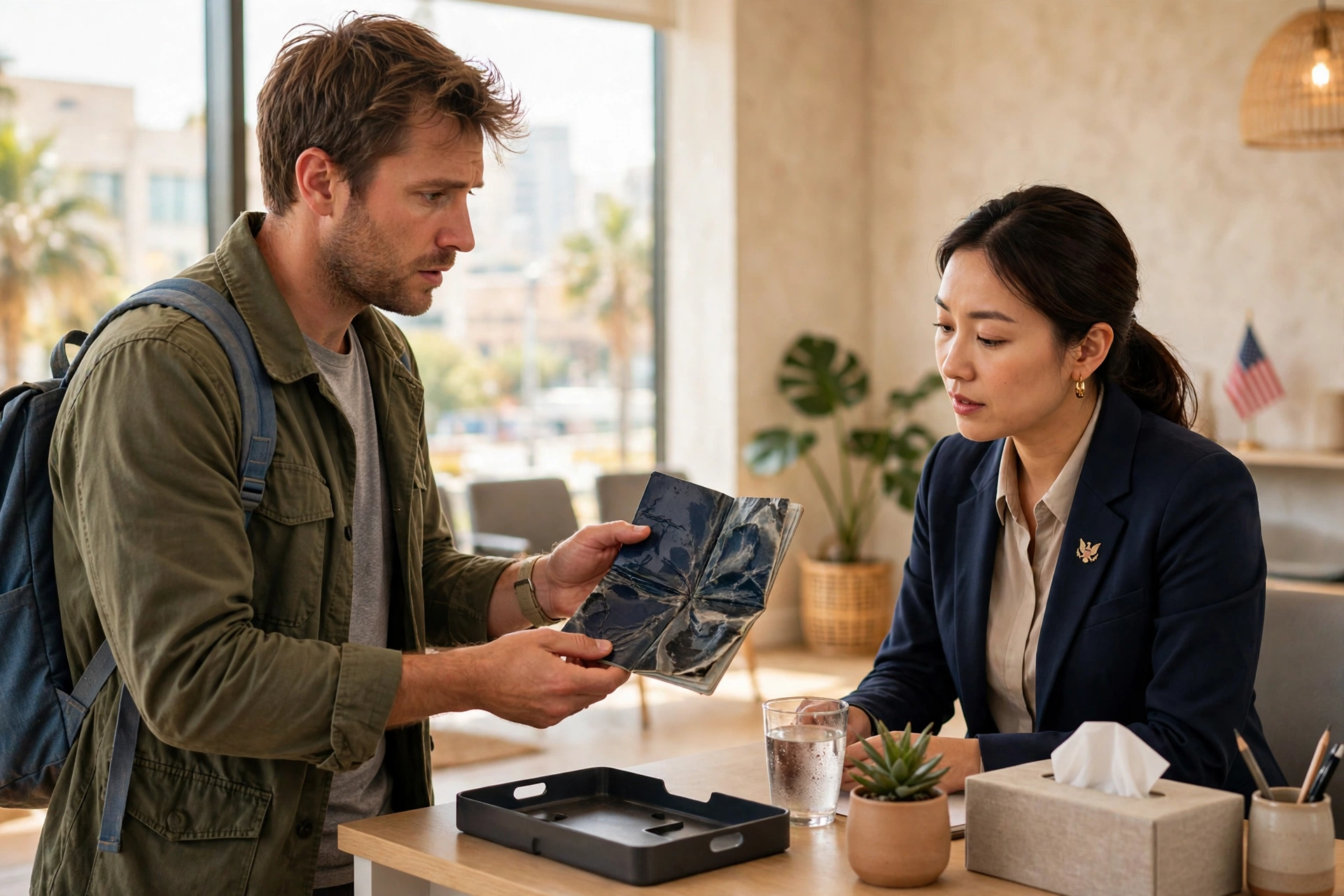
Contact the nearest US embassy or consulate, and expect to book an appointment online. AFAR says abroad you apply in person, usually by appointment.
The State Department pages we reviewed do not give step-by-step instructions for damage abroad. Take photos of the damage, bring a photo ID and any copies you have, and write a signed statement. If you need to fly soon, tell the embassy your travel date at the start. Our report stolen passport guide covers the separate case of a missing passport abroad.
How Do You Prevent Water Damage?
Keep the passport in a sealed bag or waterproof case, and check it every few months. Travisa suggests a waterproof case or plastic bag and colored photocopies as a backup.
Practical habits help:
- Keep the passport in a zip bag in rain, boat trips and beach days.
- Never leave it in a pocket that goes through the wash.
- Do not store it in a damp basement or humid bathroom.
- Carry a photocopy and a digital copy in a separate place.
- Look at the cover and pages before each trip, and renew early if you see damage.
The measurements in our passport book dimensions guide help you pick a case that fits.
How Do You Spot a Passport Repair Scam?
No company can repair or restore a damaged US passport, and only the State Department issues a replacement. Be careful with any service that claims it can fix the pages.
Be careful when a website:
- Offers to “restore” or “laminate” a water damaged passport.
- Promises a replacement in a day for a large fee.
- Asks for your passport number before you reach a government page.
- Charges extra to write your statement.
- Claims a damaged passport is still fine without any proof.
Start at travel.state.gov and follow its links to the application.
What Mistakes Cause Problems?
Traveling on a doubtful passport, repairing it yourself and forgetting the signed statement cause most problems. Check each point first.
- Assuming a dried passport is fine without checking the pages.
- Using tape, glue or a hair dryer to fix it.
- Mailing a renewal when an in-person application is needed.
- Leaving the damaged passport at home when you apply.
- Forgetting the signed statement.
- Signing the DS-11 before the agent tells you to.
- Waiting until the last month before travel.
- Missing the disaster waiver when it applies.
When unsure, ask the State Department before you travel. For related topics, see our guides on passport name change, passport signature and passport renewal.
FAQs
Can I travel with a water damaged passport?
The State Department warns airlines may deny boarding if a passport is damaged. Replace it before you travel.
What do I need to replace a damaged passport?
The damaged passport, a signed statement describing the damage, and Form DS-11 with documents, a photo and fees.
Does normal wear count as damage?
No. The State Department says not to replace a passport for normal wear and tear, such as a small bend.
Is there a fee waiver for disaster damage?
Possibly. The State Department can waive the application fee for three years after a listed disaster.
Can I renew a damaged passport by mail?
The State Department tells you to apply in person for a new passport. Do not assume a mail renewal works.
Can I fix a damaged passport myself?
No. Secondary sources warn that physical alteration can invalidate a passport, so do not repair it.
Conclusion
A water damaged passport is a risk because airlines may deny boarding and officers may refuse a damaged document. The State Department tells you to apply in person with the damaged passport, a signed statement and Form DS-11. If a listed disaster caused the damage, a fee waiver may apply under Form DS-5504. Normal wear does not need a replacement. When in doubt, replace early, keep your records and avoid anyone who offers to repair the book.