
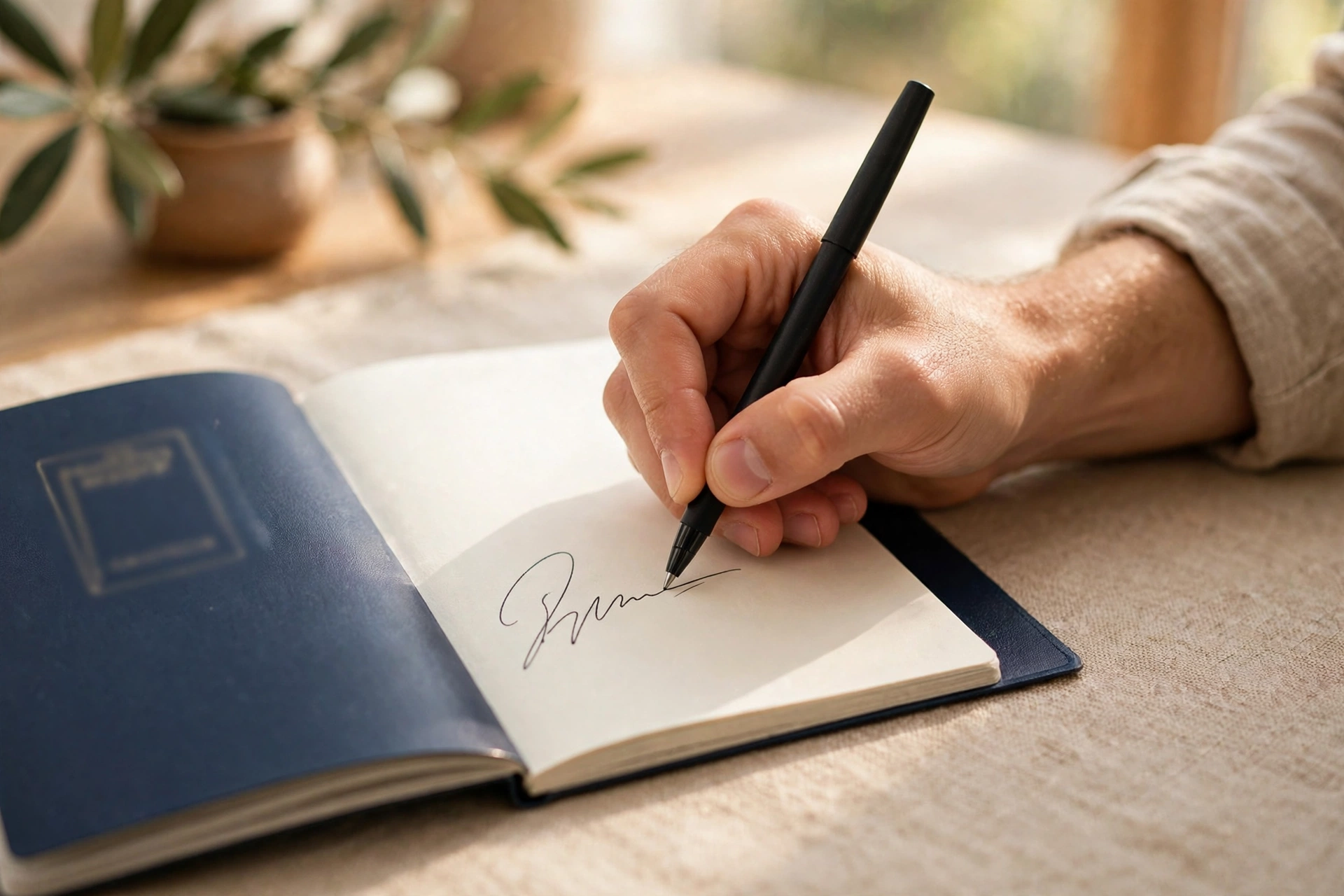
Your passport signature goes on the signature line to the right of your photo, written in your full name in blue or black ink, and you should sign as soon as the passport arrives. For a child under 16, a parent prints the child’s name on that line and signs beside it.
A new passport book arrives with the signature line empty, and the signature is yours to add. It looks like a small task, yet it raises real questions. Which ink works? Should the signature match your driver’s license? Who signs for a child? What if you make a mistake? This guide answers those questions, explains how the passport signature differs from the signatures on your application, covers the rules for minors, and lists the mistakes that cause trouble. The core rules come from the State Department’s page on what to do after getting your passport, last updated on 11 May 2026. Extra detail on ink, validity and passport cards comes from a legal explainer published on 6 April 2026, which is a secondary source that cites federal rules. Check travel.state.gov if your case is unusual. For the full overview of the process, start with our US passport guide.
Why Does Your Passport Signature Matter?
The signature is part of the document, and a secondary source says an unsigned passport book is not valid for international travel. It also gives border staff a sample of your handwriting.
The legal explainer ties the requirement to 22 CFR 51.4, the federal rule on passport validity, and describes the space as the line labeled for the bearer’s signature near the photo on the data page. We could not open the rule text itself during research, so treat that detail as secondary and confirm it if it matters for your trip. The State Department page is plain on the action itself: when you get a new passport, you need to sign it. Do it the day it arrives, before you put it in a drawer or a travel bag. A signed passport is ready to use, and there is no reason to wait until the airport.
Where and When Do You Sign?
Sign on the signature line to the right of your photo, near the spine, once you receive the book. Use your full name.
The State Department tells adults to sign their full name in blue or black ink inside the passport. The page does not give separate instructions for applicants aged 16 and 17, so they follow the adult rule, which the legal explainer also states. Take a minute before you start. Place the passport on a flat, hard surface, use a pen that does not smear, and keep your hand steady. Do not sign outside the line, and do not add a title, date or doodle. If you plan to renew later, remember that the new book will need its own passport signature, since the old one does not carry over.
Who Signs and How?
Adults sign for themselves, and a parent signs for a child under 16. The table summarizes the rules from the sources.
| Passport holder | Who signs | How |
| Adult | The holder | Full name in blue or black ink |
| Age 16 or 17 | The holder, per the adult rule | Full name in blue or black ink |
| Child under 16 | A parent or guardian | Print the child’s full name on the line, then sign beside it and print your relationship |
| Passport card | No signature needed, per a secondary source | Check travel.state.gov to confirm |
The State Department page gives the child rule in two parts. A parent should print the child’s full name on the signature line, and the parent should also print their relationship to the child, such as mother, father or guardian. The page does not name an ink color for children, so use blue or black to stay safe. The 16 and 17 row is based on the State Department’s adult wording and the legal explainer, since the State Department page does not give a separate rule for that age group.

Which Ink Color Works?
Blue or black ink are both acceptable, and you should avoid other colors. The State Department states blue or black.
The legal explainer adds an opinion that other colors are not acceptable, though it notes the federal rule does not spell out what happens with unusual inks. It also offers a view that blue may make an original easier to tell apart from a photocopy, while black gives sharper contrast. Those points are opinion, not State Department guidance. The practical answer is simple. Use a ballpoint or gel pen in dark blue or black, and avoid felt tips, metallic inks, pencils and colored novelty pens. A pen that bleeds through the page can make the signature hard to read, so test it on scrap paper first.
Should Your Signature Match Your Other IDs?
No federal rule in the sources requires a match, but using your normal signature is the safer habit. The legal explainer says border agents occasionally compare it with other ID.
That advice comes from a secondary source, and it does not cite a rule that demands a match. Still, a signature that looks nothing like the one on your driver’s license can raise a question you do not need. Sign the way you sign checks, contracts and bank forms. Avoid a new fancy version made just for the passport. If you want to change your handwriting over time, that is your right, but expect to explain the difference if someone asks. Your passport signature should look like you wrote it in a normal moment.
How Is It Different From the Signature on Your Application?
The application signature happens at the acceptance facility under an agent’s eye, while the passport signature happens at home after delivery. They are separate steps with separate rules.
On Form DS-11, you do not sign until the agent tells you to. The acceptance facility rules in our passport acceptance facility guide explain why: the agent must watch you sign. The signature on a renewal form follows its own instructions, which our passport renewal and renew passport online guides cover. Neither of those signatures replaces the one in your book. Many people forget the last step because the passport arrives in a sealed envelope and feels finished. It is not finished until you sign it. Our passport application guide walks through the whole path from form to delivery.

What Happens If You Make a Mistake?
The State Department page does not say what to do about a wrong signature, so contact the State Department or your acceptance facility before you try to fix it. Do not cover or scratch out the mark.
The legal explainer says minor slips are fine, but a wrong name, wrong ink or damage may require contact with the State Department or an acceptance facility. It adds that a damaged-looking passport may need a new application on Form DS-11. We found no official page that sets out a correction process, so rely on that general advice and ask before you act. Never use correction fluid, tape or a second layer of ink. Those marks can look like tampering. Our passport name change guide covers the case where the name itself is the problem, and our passport photo requirements guide covers the photo side of the same data page.
What If You Travel Without Signing?
Do not test it. A secondary source says an unsigned passport book is not valid for international travel, so sign before you go. The risk is not worth a pen stroke.
If you notice the blank line at the airport, sign it there with a proper pen rather than leaving it empty, and then ask the airline or the border officer if there is any question. This guidance is practical, not official. The State Department page does not address the question of an unsigned passport, so we cannot cite a rule for the outcome at the gate. The safest approach is to sign at home. Add the check to your travel list, next to the validity date and the blank pages. Our passport 6 month rule and passport pages guides cover those two checks.

How Do You Handle a Child’s Passport Signature?
A parent prints the child’s full name on the line, signs next to it and prints the relationship. The child does not sign a passport for a child under 16.
Here is a simple method:
- Use blue or black ink.
- Print the child’s full name on the signature line.
- Sign your own name beside it.
- Print your relationship, such as mother, father or guardian.
- Check that everything fits on the line without crowding the photo.
A child’s passport is valid for a shorter time than an adult’s, so you will do this again at the next renewal. If a child turns 16 before the passport expires, the passport still carries the parent’s signature, which is normal. When the next book arrives, the teenager signs it. Keep the process simple and consistent, and avoid cartoon-style signatures on a child’s passport even if the child asks.
What About a Passport Card?
A secondary source says the signature rule applies only to passport books, and a passport card is valid without one. The State Department page does not address signing the card.
The legal explainer cites Part 51 of the federal regulations for this point. Our passport card vs book guide explains the two formats and who needs which. If you hold both a book and a card, sign the book and leave the card as issued unless an official source tells you otherwise. Because the sources here are limited, check travel.state.gov for the current instruction on the card before you decide.
How Do You Spot a Passport Signature Scam?
No one needs to charge you to sign your own passport, and no service can sign it for you. Treat any such offer as a warning.
Be careful when a website or caller:
- Charges a fee to “verify” or “register” your passport signature.
- Offers to sign the passport on your behalf.
- Claims your passport is invalid until you pay for a signature check.
- Asks you to email a photo of your signed passport page.
- Promises a replacement passport for a smudged signature without an application.
The State Department does not ask for payment to sign a passport. If you receive a message like this, go to travel.state.gov yourself and do not use the link in the message.
What Mistakes Cause Problems?
Forgetting to sign, using the wrong ink and signing a child’s passport incorrectly cause most problems. Check each point first.
- Leaving the signature line empty after delivery.
- Using a pen color other than blue or black.
- Signing in pencil or with a pen that smears.
- Writing a nickname instead of a full name.
- Letting a child under 16 sign without the parent’s printed name.
- Forgetting to print the parent’s relationship.
- Covering a mistake with tape or correction fluid.
- Waiting until the airport to sign.
When unsure, ask the State Department before you write. For related topics, see our guides on expedited passport and how long it takes to get a passport.
FAQs
What ink color should I use for my passport signature?
Blue or black ink, according to the State Department. Avoid pencil, felt tips and unusual colors.
Where do I sign my passport?
On the signature line to the right of your photo, near the spine, using your full name.
Who signs a child’s passport?
A parent prints the child’s full name on the line, signs beside it and prints their relationship to the child.
Does my passport signature have to match my license?
No rule in our sources requires it, but a secondary source says border agents may compare it with other ID, so use your normal signature.
Is an unsigned passport valid?
A secondary source says an unsigned book is not valid for international travel. Sign it when it arrives.
What if I sign it wrong?
The State Department page does not say. Contact the State Department or your acceptance facility before trying to fix it.
Conclusion
Your passport signature takes seconds, but it matters. Sign your full name in blue or black ink on the line beside your photo as soon as the book arrives. For a child under 16, a parent prints the child’s name, signs and states the relationship. Use your normal handwriting, avoid fixes that look like tampering, and ask the State Department if a mistake happens. Treat the signature as the final step of your passport application.










