
United States (US) citizens need a visa before flying to India, and the fastest route is the electronic tourist visa (e-Tourist Visa), which takes 10 to 15 minutes to apply for at indianvisaonline.gov.in. Three versions exist: 30 days, 1 year and 5 years. Every step of the Indian visa for US citizens appears below, from eligibility and fees to the arrival card and scam warnings. Fees, rules and dates were checked on September 30, 2026 against the government e-Visa portal, its fee schedule dated September 8, 2026, and the websites of Indian consulates in the US.
Do US citizens need a visa to visit India?
Yes. Americans need a valid visa before boarding a flight to India, either an electronic visa (e-Visa) or a regular paper visa. Overseas Citizen of India (OCI) cardholders are the exception, because the card replaces the visa. Only nationals of three countries, Japan, South Korea and the United Arab Emirates, can get a visa on arrival. A traveler flying out of Chicago without an approved e-Visa therefore can’t board the flight to Delhi.
What types of Indian visas can US citizens apply for?
The e-Visa portal offers e-Tourist, e-Business, e-Medical, e-Medical Attendant, e-Student and e-Transit categories, and VFS Global handles regular paper visas for applicants in the United States. Business travelers receive a 365-day e-Business Visa with each stay capped at 180 days, and anyone who stays longer registers with the Foreigners Regional Registration Office (FRRO) within 2 weeks after day 180. Medical patients can bring attendants, but the portal grants only 2 e-Medical Attendant visas per patient. Tourists need the e-Tourist Visa, which the rest of this guide covers.
Who is eligible for the India e-Visa?
Americans who visit India only for recreation, sightseeing, family visits, short courses, volunteer work, medical treatment or business qualify for the e-Visa. Short courses count when the subject is local languages, music, dance, cooking or arts and crafts, the course runs 6 months or less, and no certificate or diploma is awarded. Unpaid volunteer work qualifies for up to 1 month. Four categories of traveler can’t use the e-Visa:
- Travelers of Pakistani origin, including US citizens whose parent or grandparent was born in or permanently lived in Pakistan
- Serving or retired defense, military, security or police personnel
- Holders of diplomatic or official passports
- Travelers who come for employment, journalism or non-governmental organization (NGO) activities

Applicants in these categories apply for a regular visa. A family of four needs four passports, four applications and four fees, because the portal doesn’t allow a child to be endorsed on a parent’s passport.
Which e-Tourist Visa should a US citizen choose?
Choose the 30-day visa for one short trip, the 1-year visa for one or two trips within 12 months, and the 5-year visa for repeat travel.
| Version | Validity | Entries | Maximum stay |
| 30-day | 30 days from first arrival | Multiple | 30 days |
| 1-year | 365 days from the date the Electronic Travel Authorization (ETA) is granted | Multiple | 180 days per calendar year |
| 5-year | 5 years from the date the ETA is granted | Multiple | 180 days per calendar year |
Price pushes the decision in the same direction. Two separate 30-day visas cost $50 at the July–March rate, while one 1-year visa costs $40. Validity on the longer versions starts at the grant date, not the arrival date, so a 1-year ETA granted on March 1 expires 365 days later even when the traveler lands in June. Submit the application close to the travel date.
What documents does a US citizen need for the India e-Visa?
A US citizen needs a valid passport, a scanned passport bio page, a recent digital photo, a return or onward ticket, and a payment method.
- Passport: valid for at least 6 months from the arrival date, with 2 blank pages
- Bio page scan: Portable Document Format (PDF) file, 10 kilobytes (KB) to 300 KB
- Photo file: Joint Photographic Experts Group (JPEG) file, 10 KB to 1 megabyte (MB, or 1,024 KB), with equal height and width
- Photo content: full face, front view, eyes open, no spectacles, plain light or white background, no shadows or borders
- Travel proof: return or onward ticket, with sufficient money for the stay
- Payment: Visa or MasterCard credit or debit card, or PayPal
Unclear or off-specification uploads can sink an application. A 900 KB JPEG meets the size rule; a 1.5 MB JPEG doesn’t.
How much does the Indian visa for US citizens cost?
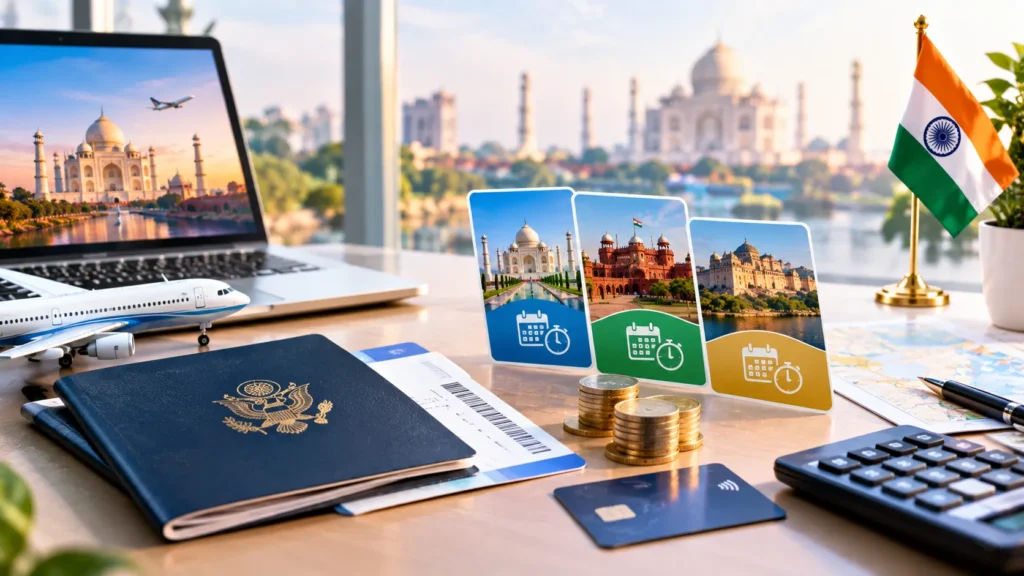
The Indian visa for US citizens costs $10 or $25 for 30 days, $40 for 1 year and $160 for 5 years, plus a 3% bank charge on card payments.
| Version | Government fee | With 3% card charge |
| 30-day, April–June | $10 | $10.30 |
| 30-day, July–March | $25 | $25.75 |
| 1-year | $40 | $41.20 |
| 5-year | $160 | $164.80 |
The 30-day fee changes by season, dropping to $10 from April to June. PayPal carries a 4% charge instead of 3%. Nothing else is billed: the portal lists no other fee, and the processing fee stays non-refundable whether the ETA is granted or rejected. Two adults who apply for 1-year visas by card pay $82.40 in total. The 5-year version averages $32 per year for travelers who return annually.
When should US citizens apply for the India e-Visa?
Apply between 120 days (about 4 months) and 4 days before the arrival date. The portal doesn’t publish a guaranteed approval time. Decisions arrive by email as Granted or Rejected, and any re-upload request for an unclear document normally comes within 24 hours. Sherpa, an independent visa service, reports that most applications are approved within 5 business days. For a landing on October 20, the cutoff is October 16, and an application filed on October 6 leaves 14 days for corrections.
Where can US citizens enter India on an e-Visa?
An e-Visa holder can enter India only through designated airports and seaports, never through land borders. The portal’s entry list names 36 airports, including Delhi, Mumbai, Chennai, Kolkata, Bengaluru, Hyderabad, Cochin and Goa. Cruise passengers can arrive at designated seaports such as Mumbai, Chennai, Cochin and Goa. Departure works through any Indian immigration checkpost.
How long can US citizens stay in India on a tourist visa?
The 1-year and 5-year e-Tourist Visas allow up to 180 days per calendar year, and the 30-day visa allows up to 30 days. The 180-day cap covers e-Tourist and regular paper tourist visas combined. Extension and conversion aren’t available for any e-Visa. A visitor who spends 120 days in India from February to May has 60 days left in that calendar year.
What is the difference between the e-Visa and the 10-year paper visa?
The e-Visa is approved online for up to 5 years, while the regular paper tourist visa is processed through VFS Global and can be valid for 10 years. The Government of India restored 10-year paper tourist visas for US nationals on March 16, 2022. Both visa types cap stays at 180 days per calendar year, and neither permits entry through land borders. Consulates process paper visas in up to 5 business days after receiving a complete application. Someone who plans yearly visits through 2036 needs one 10-year paper visa or two 5-year e-Visas, which cost $320 before the 3% bank charge. VFS Global publishes the current paper-visa fee.
How do US citizens apply for the India e-Visa?
Applicants complete four stages at indianvisaonline.gov.in/evisa: submit the application, pay the fee, receive the ETA by email, and show the ETA at Indian immigration.

- Open indianvisaonline.gov.in/evisa and select the e-Tourist Visa version: 30-day, 1-year or 5-year.
- Complete the form and upload the photo and passport bio page, which takes 10 to 15 minutes.
- Pay the fee by card or PayPal and wait up to 2 hours for the payment status to update.
- Check the application status until the ETA reads GRANTED, then print the ETA.
- Carry the printed ETA to the immigration checkpost, where officers stamp the e-Visa in the passport.
A confirmation email arrives right after payment. Anyone who stops midway can resume through the portal’s Complete Partially Filled Application Form option.
Why do India e-Visa applications get rejected?
The portal rejects applications with unclear or off-specification uploads, and it refuses applicants who fall outside the eligibility rules. Most problems have a direct fix:
- Blurry or oversized uploads: rescan the bio page as a PDF of 10 to 300 KB and resize the photo to 1 MB or less
- Mismatched details: compare the name, passport number and date of birth with the passport before final submission
- Late payment: pay at least 4 days before the expected travel date
- Ineligible background: apply for a regular visa when the applicant has Pakistani origin or a defense, military, security or police background
Concealing a professional background carries a steeper penalty than rejection, because the government can deny entry and deport the traveler. A rejected 1-year application still costs $40.
How do US citizens avoid fake India e-Visa websites?
Apply only at indianvisaonline.gov.in/evisa, the Government of India’s single official e-Visa site. The government states that no intermediary or agent is required, that the portal charges no emergency or express fee, and that the only fee is the non-refundable processing fee. Independent services add their own charges. On September 30, 2026, Sherpa, which states it isn’t affiliated with any government agency, listed these prices:
| Version | Government portal (fee + 3% card charge) | Sherpa listing |
| 30-day (July–March) | $25.75 | $79.89 |
| 1-year | $41.20 | $95.00 |
| 5-year | $164.80 | $245.80 |
Extras such as application review explain the gap, and those extras are optional. Passport details typed into an unofficial site risk leaking personal data, according to the government.
What rules apply after the e-Visa is granted?
An e-Visa holder must travel on the passport named in the application, carry the printed ETA, and stay within the visa’s validity and area limits.
- Travel on the passport named in the application, and carry the old passport as well if a new one was issued after the ETA.
- Carry a printed copy of the ETA and confirm its status shows GRANTED before departure.
- Avoid Protected, Restricted and Cantonment areas unless the civil authority grants prior permission.
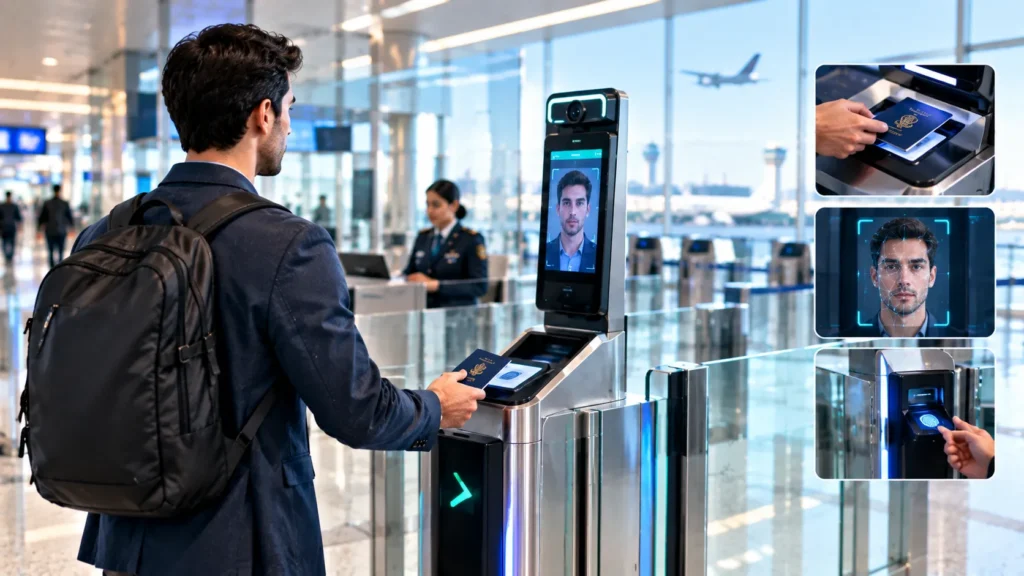
- Expect biometric capture at immigration on arrival.
A traveler whose ETA was issued on a 2021 passport and who now holds a passport issued in 2026 carries both booklets.
Do US citizens need a yellow fever vaccination card for India?
No. Americans need the original yellow fever certificate only if they arrive within 6 days of leaving a yellow-fever-endemic country. Travelers without the certificate may be quarantined for 6 days. A visitor flying from São Paulo to Delhi within 6 days of leaving Brazil carries the original certificate. The Ministry of Health and Family Welfare publishes the list of endemic countries.
Who can help with India e-Visa problems?
The e-Visa Support Centre handles ETA errors and application questions, and the payment helpdesks handle failed or duplicate payments.
- ETA and application errors: indian-evisa@gov.in, +91 82 7808 7808 or +91 11 24300666
- Axis Bank payments from the US: 1 855 205 5577 (toll-free), then option 6 on the interactive voice response (IVR) menu
- State Bank of India (SBI) ePay payments: +91 22 6536 1671, available 24 hours a day
A misspelled surname on the ETA, for example, needs a report at least 24 hours before departure. The Indian Embassy in Washington, D.C. doesn’t process e-Visas, so every e-Visa inquiry goes to the portal.
Do US citizens need the e-Arrival Card?
Yes. Every foreign traveler, including Americans, must submit the electronic arrival card (e-Arrival Card) online within 72 hours before arriving in India. The paper disembarkation form was discontinued on April 1, 2026, and the e-Arrival Card isn’t a visa. Travelers file the card at boi.gov.in, at indianvisaonline.gov.in or in the official Indian Visa Su-Swagatam mobile app, then show the quick response (QR) code at immigration. A passenger landing in Mumbai at 6:00 AM on Tuesday can submit from 6:00 AM the previous Saturday.
Frequently asked questions
Can US citizens get an Indian visa on arrival?
No. India offers visa on arrival only to nationals of Japan, South Korea and the United Arab Emirates, so Americans must hold an approved e-Visa or paper visa before departure.
How long is the 5-year e-Tourist Visa valid?
Five years from the date the ETA is granted, with multiple entries and a maximum stay of 180 days per calendar year.
Is the e-Visa fee refundable after a rejection?
No. The fee covers application processing, so the government keeps it whether the ETA is granted or rejected.
Can an e-Visa be extended while in India?
No. Every e-Visa is non-extendable and non-convertible, and the 180-day yearly cap for tourist visas still applies.
Do children need their own e-Visa?
Yes. Each child needs a separate passport and a separate application, and the passport must stay valid for at least 6 months from the arrival date.
Does India require travel insurance for US visitors?
No. The e-Visa requirements don’t list insurance. Assist Card notes that free or subsidized public healthcare in India serves citizens only, so private medical coverage pays for hospital stays and emergency treatment.
Where do US citizens apply for the Indian e-Visa?
Only at indianvisaonline.gov.in/evisa, the Government of India’s official portal. The Indian Embassy in Washington, D.C. warns against lookalike sites.
What happens if the ETA contains a spelling error?
Contact the e-Visa Support Centre at indian-evisa@gov.in or +91 82 7808 7808 at least 24 hours before departure. The applicant bears responsibility for mistakes made during the application.
Conclusion
Apply only at indianvisaonline.gov.in/evisa, the official site for any Indian visa for US citizens. Submit the form between 120 and 4 days before landing, print the granted ETA, and file the e-Arrival Card in the 72 hours before arrival. Travelers who return every year pay the least per year on the 5-year version. At $160, that visa works out to $32 per year, before the 3% bank charge.