
Dubai International Airport (DXB) admits citizens of more than 70 countries without an advance visa, and travelers from every other country need a visa, a transit permit, or a qualifying residence permit before landing. The rules split into four groups: Gulf Cooperation Council (GCC) nationals, visa-free visitors, conditional visa-on-arrival travelers, and everyone who applies in advance. Students add a fifth path, because the United Arab Emirates (UAE) requires a university-sponsored entry permit and residence visa for most people who study there.
Dubai International Airport handled 95.2 million passengers in 2025 and kept its position as the world’s busiest international airport. Its entry rules change more often than most travelers expect. The UAE added six nationalities to a conditional visa-on-arrival scheme on June 25, 2026, and imposed Ebola-related visa restrictions on June 6. This guide sorts current rules by passport group, covers the student route, and explains passport control, transit, and terminals.
Which Passport Holders Can Enter Dubai International Airport Without an Advance Visa?
Citizens of the five GCC states enter without a visa, and passport holders from 49 nations receive visa-free entry for 90 days within any 180-day period. Bahrain, Kuwait, Oman, Qatar, and Saudi Arabia make up the GCC group, and its citizens can enter with a passport or a national ID card. The 90-day group includes the United States, the United Kingdom, Canada, Australia, Japan, South Korea, Brazil, Argentina, and every European Union (EU) member state except Ireland. Visa-free entry carries no fee and no permission to work, so employment requires a separate visa.
A second group receives 30 days. Ireland, Malaysia, Mongolia, Ukraine, Uzbekistan, Hong Kong, Macau, Kazakhstan, Mauritius, Brunei, Andorra, Monaco, and Vatican City belong to it, and most of these nationalities can extend the stay by 30 days. A Malaysian visitor, for example, receives 30 days on arrival, while a Brazilian visitor receives 90.
Published lists disagree on some passports. One 2026 guide places the United States and the United Kingdom in the 30-day group, while the UAE Embassy in Washington, DC, states 90 days for US citizens. Confirm the figure for your passport with the Federal Authority for Identity, Citizenship, Customs and Port Security (ICP) at icp.gov.ae or the General Directorate of Residency and Foreigners Affairs (GDRFA) in Dubai must be contacted before booking.

Who Qualifies for the Conditional Visa on Arrival?
Nationals of India, Indonesia, Kenya, the Philippines, South Africa, Thailand, and Vietnam qualify for a 14-day or 60-day visa on arrival if they hold a valid residence permit from an approved country. The approved issuers are the United States, an EU member state, the United Kingdom, Singapore, Japan, South Korea, Australia, New Zealand, and Canada. ICP added the last six nationalities on June 25, 2026, and accompanying family members qualify alongside the applicant.
The permit must be valid on the travel date. A Kenyan engineer holding a current United Kingdom residence permit qualifies, while a Kenyan citizen without one applies for a visa before flying. An expired permit, even one that lapsed last month, does not count.
What Should Travelers From Other Countries Do Before Flying?
Travelers whose passports fall outside every group above must obtain a UAE visa before boarding. Dubai Airports directs these travelers to GDRFA and their airline for cost and procedure, and it warns that visa rules change. Requirements also depend on the purpose of travel, so a tourist, a worker, and a student follow different applications.
Health measures override the nationality lists. On June 6, 2026, the UAE suspended new visas for nationals of the Democratic Republic of the Congo, South Sudan, and Uganda because of Ebola. The suspension covered visit, work, residence, and investment visas. Travelers arriving from those countries, including through third countries, faced refusal unless they had spent at least 21 days elsewhere first.
On September 26, 2026, the UAE eased the measures for Uganda. Restrictions on the Democratic Republic of the Congo and South Sudan remain. Students from those countries should ask their university about visa status before booking a flight, and every traveler should recheck ICP before departure.
What Do Immigration Officers Check at Dubai International Airport?
Immigration officers check a valid passport, an onward or return ticket, and a biometric scan at the counter. The UAE Embassy in Washington, DC, lists a passport valid at least six months beyond the arrival date for US citizens, and travelers of other nationalities should confirm the same rule with their airline. Some visitors also complete an eye scan.
Unresolved questions go to the GDRFA visa office in Terminal 3 arrivals near Entrance 1, which stays open 24 hours a day. A passport that expires in four months, for instance, gets a definitive answer there before the traveler reaches a queue.
How Does Passport Control Work at Dubai International Airport?
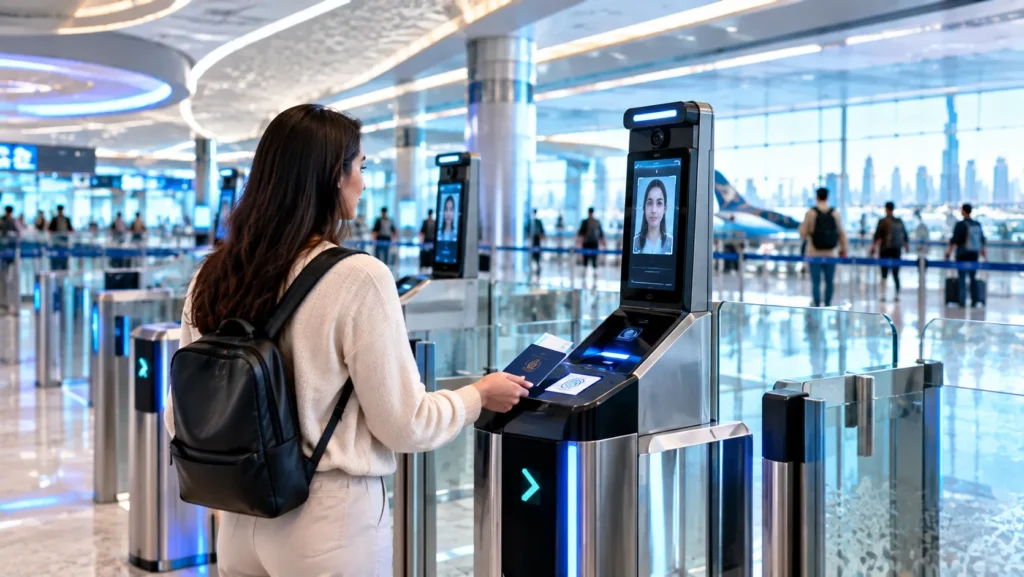
Passport control at DXB runs through two routes: staffed counters and automated Smart Gates. Dubai Airports lists UAE and GCC nationals, UAE residents, visa-on-arrival visitors, travelers from Schengen countries, and holders of pre-issued UAE visas among eligible users. Registered users look at a biometric camera and clear immigration in seconds, and first-time users register at the passport control touchpoint on arrival.
Smart Gates PreCheck, launched in July 2026 with GDRFA, confirms eligibility before the queue. Travelers scan a passport through the Pocket Flights platform or QR codes displayed around passport control, and a result appears within seconds. PreCheck does not replace passport control, issue immigration approval, or change visa conditions. More than 9 million passengers cleared immigration through Smart Gates in the first half of 2026.
Families traveling with children cannot use Smart Gates. Travelers below 1.2 meters (3 ft 11 in), passengers with large strollers, and People of Determination also use staffed counters. At a gate, follow four steps: step onto the marked footprints, remove hats, glasses, and masks, look at the camera and green light, and wait for the gate to open.
How Do Students Enter the UAE to Study?
Most international students need a university-sponsored entry permit before travel and a one-year residence visa after arrival. Citizens of the five GCC states are excluded from the requirement. The university, or in some cases a parent or guardian living in the UAE, acts as sponsor, and GDRFA approves the application in the relevant emirate. Six steps cover the standard route:
- Accept an offer from a UAE-accredited institution and pay the initial fees.
- Send the university’s visa office a passport copy, photos, the admission letter, and the fee receipt.
- Wait while the university files the entry permit application with GDRFA.
- Enter the UAE on the entry permit, which typically stays valid for 60 days.
- Complete the medical fitness test, which includes a chest X-ray for tuberculosis screening.
- Register biometrics for the Emirates ID and receive the residence visa.
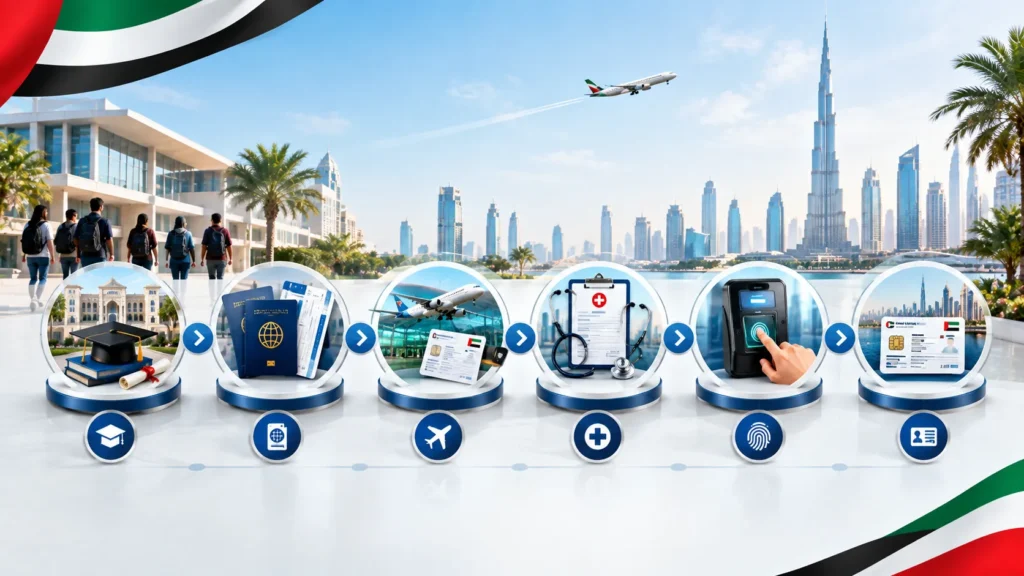
Timing matters after the medical test. One Dubai university reports that biometric appointments for the Emirates ID arrive 7 to 10 business days after a student passes, and that a temporary application form covers the gap until the card is delivered.
What Documents Do Students Carry?
The core file has five items:
- A passport valid at least six months when the application is filed
- The digital entry permit issued through the university
- The admission letter and tuition fee receipt
- Attested academic certificates, where the university requires them
- Proof of health insurance, where the university or emirate requires it
Certificates issued outside the UAE need an apostille or embassy legalization plus attestation by the UAE Ministry of Foreign Affairs, a process that takes about 2 to 4 weeks. A student who starts attestation the week the offer arrives avoids a missed intake date.
How Long Does a Student Visa Last, and Can Students Work?
A student residence visa lasts one year and renews annually through the university. Renewal starts at least 45 days before expiry, and the student cannot leave the UAE or apply for another visa category until the new visa is issued. Overstaying an entry permit costs 50 United Arab Emirates dirhams (AED) per day, roughly $13.60 (USD). Students who want to work need a separate permit from the Ministry of Human Resources and Emiratisation plus university permission.
Do Travelers and Students Need a Visa to Connect Through Dubai International Airport?
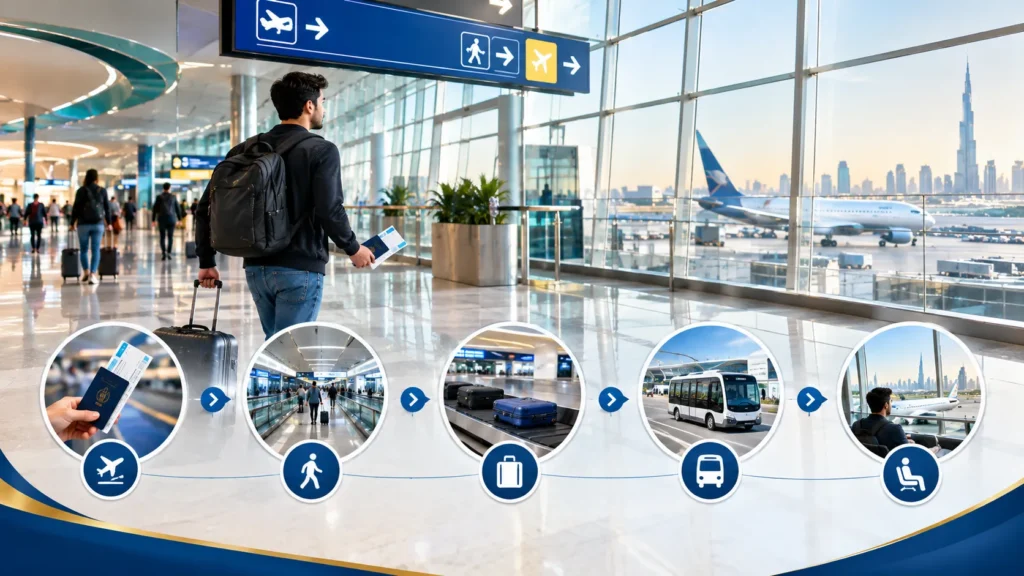
No, passengers who stay airside without crossing immigration do not need a visa, regardless of nationality. Airline staff route through-ticket passengers along the Connections signs. A student flying from Lagos to Toronto on one ticket via Dubai stays airside and never enters the UAE.
Separate tickets change the process. Passengers on separately booked flights may have to clear immigration, collect baggage, pass through customs, and leave the terminal before continuing. Travelers who qualify for visa-free entry or visa on arrival follow the rules for their nationality, and those who don’t qualify can arrange a 48-hour or 96-hour transit visa through the airline before travel.
Connection times deserve attention. Terminals 1 and 2 have no walkable or train link, so through-ticket passengers ride a connection bus, and flydubai publishes a 120-minute minimum for its Terminal 2 to Terminal 3 connection.
Which Terminal Serves Your Flight?
Terminal 1 (T1) serves most international airlines, Terminal 2 (T2) serves flydubai and regional carriers, and Terminal 3 (T3) serves Emirates. The boarding pass names the terminal, and last-minute changes happen.
| Terminal | Main users | Ground link |
| T1 | Most international airlines other than Emirates; Concourse D | Dubai Metro Red Line station |
| T2 | Flydubai, charter flights, regional carriers | Free shuttle bus; no Metro station |
| T3 | Emirates; Concourses A, B, and C | Dubai Metro Red Line station |
T2 sits about 7 km (4.3 miles) from the other two buildings, and the city lies about 5 km (3 miles) from the airport. Emirates advises allowing about 30 minutes to travel between T3 concourses, so a gate change from Concourse A to Concourse C isn’t a short walk.
Is Dubai International Airport Operating Normally in 2026?
Yes, DXB is open and operating, although regional tensions have disrupted individual airlines and schedules. Dubai Airports has not announced a closure at DXB or at Dubai World Central–Al Maktoum International Airport (DWC). A late-September Khaleej Times headline reported 46 flights delayed or cancelled across UAE airports, so schedules still move. Dubai Airports forecast more than 265,000 travelers per day during the summer peak.
Government advisories reflect the risk. The US State Department rates the UAE Level 3, Reconsider Travel, according to the US Mission’s September 19, 2026 alert, and Australia’s Smartraveller carries a matching Level 3 setting. Check your own government’s advisory before booking and again before departure, and confirm flight times in the airline’s app on the day of travel.
FAQs
Do Americans and Europeans need a visa for Dubai?
No. US citizens and every EU state’s citizens except Ireland enter visa-free for 90 days within 180 days. Irish citizens receive 30 days. No work is permitted on visa-free entry.
Which nationalities get 30 days visa-free?
Ireland, Malaysia, Mongolia, Ukraine, Uzbekistan, Hong Kong, Macau, Kazakhstan, Mauritius, Brunei, Andorra, Monaco, and Vatican City. Most can extend the stay by 30 days.
Can Indian passport holders get a visa on arrival?
Yes, but only with a valid residence permit from the US, an EU state, the UK, Singapore, Japan, South Korea, Australia, New Zealand, or Canada. Stays run 14 or 60 days.
Do students need a visa to study in the UAE?
Yes. Non-GCC students need a university-sponsored entry permit, then a residence visa issued after the medical test and Emirates ID registration.
How long does a student residence visa last?
One year. Renewal runs through the university and starts at least 45 days before expiry. Students cannot leave the UAE while the renewal is pending.
Can passengers connect through DXB without a visa?
Yes, when they stay airside on a through-ticket. Leaving the terminal means entering the UAE, which requires visa-free status, visa on arrival, or an approved visa.
What is Smart Gates PreCheck?
A July 2026 service that confirms Smart Gate eligibility after a passport scan through Pocket Flights or QR codes. It grants no immigration approval.
Are Ebola-related visa restrictions still active?
Yes, for nationals of the Democratic Republic of the Congo and South Sudan. The UAE eased Uganda’s measures on September 26, 2026. Verify status with ICP before booking.
Conclusion
Verify the rule for your specific passport on icp.gov.ae or with GDRFA, as published lists conflict for some nationalities. Students ask the university’s visa office for the entry permit before buying a ticket. Anyone with a passport near expiry checks the six-month rule before the airline does. The GDRFA visa office in Terminal 3 arrivals, near Entrance 1, stays open 24 hours a day.